
Mars rock can provide evidence of life on Red planet
A research on terrestrial rocks suggested that by testing rocks formed from evaporated water on Mars, scientists can easily find evidence of life on the planet if it ever existed.


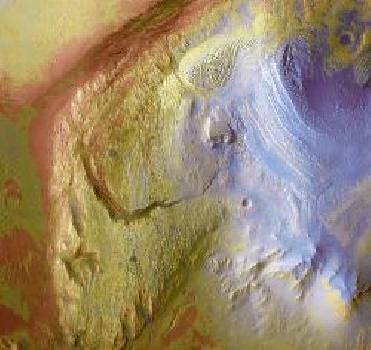
Caption: Sulphate minerals like those found in Mars's Gale Crater (pictured) could preserve evidence of past life. NASA/ JPL/Arizona State University photo
Credit 10
Credit 10

WASHINGTON (PTI): American scientists have claimed to have found an easy way to confirm if life ever existed on Mars.
A research on terrestrial rocks by the University of California, Los Angeles, suggested that by testing rocks formed from evaporated water on Mars, scientists can easily find evidence of life on the planet if it ever existed.
According to the researchers, minerals called sulphate that form in the presence of liquid water and have been found in great abundance on Mars, can preserve fossilised microbial life, rather than erasing evidence of it as previously thought, the New Scientist reported.
"Thus rocks formed from evaporated water are good places to look for potential life on Mars," the team said.
For the research, the team led by Bill Schopf has used 3D imaging to reveal a range of fossilised algae in a type of sulphate called gypsum found in northern Italy.
The gypsum formed when the Mediterranean Sea evaporated some 5.6 million years ago when tectonic activity temporarily cut it off from the Atlantic Ocean.
"We all assumed there wouldn't be anything in there, and we were wrong," Schopf said.
Finding such a "diverse assemblage of microfossils' gives us great hope that the sulphates on Mars might harbour a similar kind of suite of fossils," he said.
Because gypsum is soft, it should be fairly easy for a future Mars rover to scoop up. The sample could then be dissolved in water to hunt for organic chemicals that would hint at past life.
Alternatively, if the gypsum were brought back to earth, it could be scanned for fossil structures using high-tech imaging equipment in the lab.
A research on terrestrial rocks by the University of California, Los Angeles, suggested that by testing rocks formed from evaporated water on Mars, scientists can easily find evidence of life on the planet if it ever existed.
According to the researchers, minerals called sulphate that form in the presence of liquid water and have been found in great abundance on Mars, can preserve fossilised microbial life, rather than erasing evidence of it as previously thought, the New Scientist reported.
"Thus rocks formed from evaporated water are good places to look for potential life on Mars," the team said.
For the research, the team led by Bill Schopf has used 3D imaging to reveal a range of fossilised algae in a type of sulphate called gypsum found in northern Italy.
The gypsum formed when the Mediterranean Sea evaporated some 5.6 million years ago when tectonic activity temporarily cut it off from the Atlantic Ocean.
"We all assumed there wouldn't be anything in there, and we were wrong," Schopf said.
Finding such a "diverse assemblage of microfossils' gives us great hope that the sulphates on Mars might harbour a similar kind of suite of fossils," he said.
Because gypsum is soft, it should be fairly easy for a future Mars rover to scoop up. The sample could then be dissolved in water to hunt for organic chemicals that would hint at past life.
Alternatively, if the gypsum were brought back to earth, it could be scanned for fossil structures using high-tech imaging equipment in the lab.