NASA's Chandra discovers youngest nearby black hole
The black hole  known as SN 1979C  is expected to give scientists a rare opportunity to track the evolution of one of the more bizarre phenomena in the cosmos.


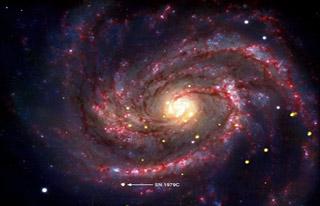
Caption: Composite image shows a supernova within the galaxy M100 that may contain the youngest known black hole in our cosmic neighborhood. Photo: X-ray: NASA/CXC/SAO/D.Patnaude et al, Optical: ESO/VLT, Infrared: NASA/JPL/Caltech.

WASHINGTON (BNS): Astronomers using NASA's Chandra X-ray Observatory have found evidence of the youngest black hole known to exist in our cosmic neighborhood.
The black hole — known as SN 1979C — is expected to give scientists a rare opportunity to track the evolution of one of the more bizarre phenomena in the cosmos.
The 30-year-old object is a remnant of SN 1979C, a supernova in the galaxy M100 approximately 50 million light years from Earth. Data from Chandra, NASA's Swift satellite, the European Space Agency's XMM-Newton and the German ROSAT observatory revealed a bright source of X-rays that has remained steady during observation from 1995 to 2007. This suggests the object is a black hole being fed either by material falling into it from the supernova or a binary companion, according to a NASA news report.
"If our interpretation is correct, this is the nearest example where the birth of a black hole has been observed, Daniel Patnaude of the Harvard-Smithsonian Center for Astrophysics in Cambridge, Mass, who led the study, was quoted as saying in the news report.
The explosion of the star was first observed by an amateur astronomer in 1979, but it took decades of observation to confirm it had become a black hole.
Many new black holes in the distant universe previously have been detected in the form of gamma-ray bursts (GRBs). However, SN 1979C is different because it is much closer and belongs to a class of supernovas unlikely to be associated with a GRB. Theory predicts most black holes in the universe should form when the core of a star collapses and a GRB is not produced.
The black hole — known as SN 1979C — is expected to give scientists a rare opportunity to track the evolution of one of the more bizarre phenomena in the cosmos.
The 30-year-old object is a remnant of SN 1979C, a supernova in the galaxy M100 approximately 50 million light years from Earth. Data from Chandra, NASA's Swift satellite, the European Space Agency's XMM-Newton and the German ROSAT observatory revealed a bright source of X-rays that has remained steady during observation from 1995 to 2007. This suggests the object is a black hole being fed either by material falling into it from the supernova or a binary companion, according to a NASA news report.
"If our interpretation is correct, this is the nearest example where the birth of a black hole has been observed, Daniel Patnaude of the Harvard-Smithsonian Center for Astrophysics in Cambridge, Mass, who led the study, was quoted as saying in the news report.
The explosion of the star was first observed by an amateur astronomer in 1979, but it took decades of observation to confirm it had become a black hole.
Many new black holes in the distant universe previously have been detected in the form of gamma-ray bursts (GRBs). However, SN 1979C is different because it is much closer and belongs to a class of supernovas unlikely to be associated with a GRB. Theory predicts most black holes in the universe should form when the core of a star collapses and a GRB is not produced.