Shedding 'Bent' light on dark matter
The new dark matter observations may yield new insights into the role of dark energy in the universe's early formative years.


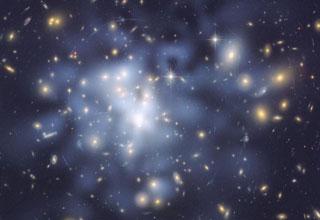
Caption: The location of the dark matter (tinted blue) was inferred through observations of magnified and distorted distant galaxies. Photo: NASA

CALIFORNIA (BNS): With the help of giant cosmic magnifying glass of NASA's Hubble Space Telescope astronomers have created one of the sharpest and most detailed maps of dark matter in the universe.
"Dark matter is an invisible and unknown substance that makes up the bulk of the universe's mass," according to the research of Astronomer Dan Coe with the NASA's Jet Propulsion Laboratory in Pasadena, California.
The astronomers used Hubble to chart the invisible matter in the massive galaxy cluster Abell 1689, located 2.2 billion light-years away.
With the effect of gravitational lensing dark matter acts like a cosmic magnifying glass, bending and amplifying the light from distant galaxies behind it.
Astronomers estimated the amount of dark matter within the cluster by studying the distorted images.
The new dark matter observations may yield new insights into the role of dark energy in the universe's early formative years.
A mysterious property of space, dark energy fights against the gravitational pull of dark matter. The new results suggest that galaxy clusters may have formed earlier than expected, before the push of dark energy inhibited their growth.
Dark energy pushes galaxies apart from one another by stretching the space between them, suppressing the formation of giant structures called galaxy clusters.
"Dark matter is an invisible and unknown substance that makes up the bulk of the universe's mass," according to the research of Astronomer Dan Coe with the NASA's Jet Propulsion Laboratory in Pasadena, California.
The astronomers used Hubble to chart the invisible matter in the massive galaxy cluster Abell 1689, located 2.2 billion light-years away.
With the effect of gravitational lensing dark matter acts like a cosmic magnifying glass, bending and amplifying the light from distant galaxies behind it.
Astronomers estimated the amount of dark matter within the cluster by studying the distorted images.
The new dark matter observations may yield new insights into the role of dark energy in the universe's early formative years.
A mysterious property of space, dark energy fights against the gravitational pull of dark matter. The new results suggest that galaxy clusters may have formed earlier than expected, before the push of dark energy inhibited their growth.
Dark energy pushes galaxies apart from one another by stretching the space between them, suppressing the formation of giant structures called galaxy clusters.