NASA space probe captures stunning images of comet Hartley 2
NASA's EPOXI spacecraft passed within 700 kilometres of Hartley 2's surface, providing the first ever close-up details.


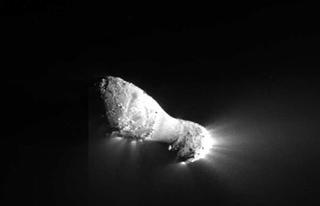
Caption: Comet Hartley 2 can be seen in glorious detail in this image from NASA's EPOXI mission. Photo by: NASA/JPL-Caltech/UMD.

PASADENA, CALIFORNIA (BNS): NASA's EPOXI mission successfully flew by comet Hartley 2 at about 7 AM PDT (1400 GMT) on Thursday, and the spacecraft has begun returning images. Hartley 2 is the fifth comet nucleus visited by a spacecraft.
Scientists and mission controllers are currently viewing never-before-seen images of Hartley 2 appearing on their computer terminal screens.
"The mission team and scientists have worked hard for this day. It's good to see Hartley 2 up close," Tim Larson, EPOXI project manager at NASA's Jet Propulsion Laboratory, Pasadena, California, was quoted as saying in a NASA news report.
NASA's EPOXI spacecraft passed within 700 kilometres of Hartley 2's surface, providing the first ever close-up details.
Scientists say initial images are giving new information about the comet's size, shape and chemical composition. Images from the EPOXI mission reveal Hartley 2 is about 2.2 kilometres long and has a mass of about 280 million tonnes.
EPOXI is an extended mission that utilizes the already "in-flight" Deep Impact spacecraft to explore distinct celestial targets of opportunity. The name EPOXI itself is a combination of the names for the two extended mission components: the extrasolar planet observations, called Extrasolar Planet Observations and Characterization (EPOCh), and the flyby of comet Hartley 2, called the Deep Impact Extended Investigation (DIXI). The spacecraft has retained the name "Deep Impact."
Scientists and mission controllers are currently viewing never-before-seen images of Hartley 2 appearing on their computer terminal screens.
"The mission team and scientists have worked hard for this day. It's good to see Hartley 2 up close," Tim Larson, EPOXI project manager at NASA's Jet Propulsion Laboratory, Pasadena, California, was quoted as saying in a NASA news report.
NASA's EPOXI spacecraft passed within 700 kilometres of Hartley 2's surface, providing the first ever close-up details.
Scientists say initial images are giving new information about the comet's size, shape and chemical composition. Images from the EPOXI mission reveal Hartley 2 is about 2.2 kilometres long and has a mass of about 280 million tonnes.
EPOXI is an extended mission that utilizes the already "in-flight" Deep Impact spacecraft to explore distinct celestial targets of opportunity. The name EPOXI itself is a combination of the names for the two extended mission components: the extrasolar planet observations, called Extrasolar Planet Observations and Characterization (EPOCh), and the flyby of comet Hartley 2, called the Deep Impact Extended Investigation (DIXI). The spacecraft has retained the name "Deep Impact."