Scientists look 10,000 years into the future
Astronomers have studied the Hubble images of the globular star cluster Omega Centauri, to look thousands of years into the future.


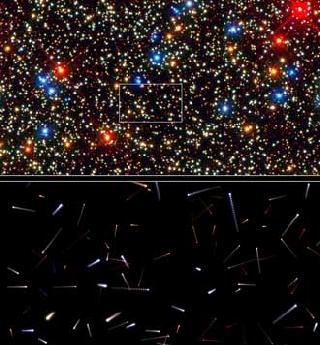
Caption: This image juxtaposes an image of the Omega Centauri cluster taken by Hubble's WFC3, with an analysis of stellar motion shown within that cluster. Photo: NASA/ESA/G. Bacon (STScI)

WASHINGTON (BNS): NASA/ ESA Hubble Space Telescope has helped scientists to calculate the movement of stars over the next 10 000 years.
Astronomers have observed the Hubble images of the globular star cluster Omega Centauri from the period between 2002 and 2006, to make a movie simulation of the frenzied motion of the cluster's stars.
The movie shows the stars' projected migration over the next 10,000 years.
The Omega Centauri was a "star", which was actually a beehive swarm of nearly 10 million stars, all orbiting a common center of gravity.
The powerful vision of NASA's Hubble Space Telescope helped the astronomers to peer deep into the core of the "beehive" and resolve individual stars.
Analysing archived images taken over a four-year period by Hubble's Advanced Camera for Surveys, astronomers have made the most accurate measurements yet of the motions of more than 100,000 cluster inhabitants, the largest survey to date to study the movement of stars in any cluster.
Omega Centauri was identified as a globular star cluster in 1867. The behemoth stellar grouping is the biggest and brightest globular cluster in the Milky Way, and one of the few that can be seen by the unaided eye.
Astronomers have observed the Hubble images of the globular star cluster Omega Centauri from the period between 2002 and 2006, to make a movie simulation of the frenzied motion of the cluster's stars.
The movie shows the stars' projected migration over the next 10,000 years.
The Omega Centauri was a "star", which was actually a beehive swarm of nearly 10 million stars, all orbiting a common center of gravity.
The powerful vision of NASA's Hubble Space Telescope helped the astronomers to peer deep into the core of the "beehive" and resolve individual stars.
Analysing archived images taken over a four-year period by Hubble's Advanced Camera for Surveys, astronomers have made the most accurate measurements yet of the motions of more than 100,000 cluster inhabitants, the largest survey to date to study the movement of stars in any cluster.
Omega Centauri was identified as a globular star cluster in 1867. The behemoth stellar grouping is the biggest and brightest globular cluster in the Milky Way, and one of the few that can be seen by the unaided eye.