F-35 Navy Jet confirms carrier-landing strength predictions
A Lockheed Martin F-35C Lightning II carrier variant has successfully completed testing in which it was dropped from heights of more than 11 feet during a series of simulated aircraft-carrier landings.


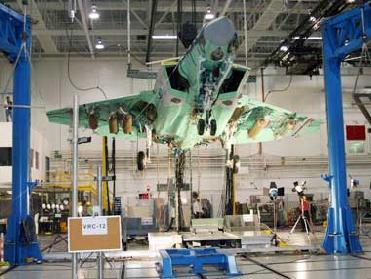
Caption: CG-1, the ground test article for the Lockheed Martin F-35 carrier variant, is positioned for its final drop test at Vought Aircraft Industries in Dallas, Tx. Vought Aircraft Industries photo
Credit 10
Credit 10

FORT WORTH, TEXAS (BNS): A Lockheed Martin F-35C Lightning II carrier variant has successfully completed testing in which it was dropped from heights of more than 11 feet during a series of simulated aircraft-carrier landings.
The jet, a ground-test article known as CG-1, underwent drop testing at Vought Aircraft Industries in Grand Prairie, Texas. No load exceedances or structural issues were found at any of the drop conditions, and all drops were conducted at the maximum carrier landing weight, a Lockheed martin statement said.
The drop conditions included sink rates, or rates of descent, up to the maximum design value of 26.4 feet per second, as well as various angles and weight distributions.
The tests were used to mimic the wide range of landing conditions expected in the fleet. This final drop test follows the recent first flight of the first F-35C.
Three F-35 variants are under development – the F-35A CTOL variant to replace US Air Force F-16s and A-10s, as well as aircraft employed by seven allied nations; the F-35B STOVL variant to replace US Marine Corps AV-8B Harriers and F/A-18s, U.K. Royal Air Force and Royal Navy Harrier GR.7s, GR.9s and Sea Harriers, and Italian Harriers; and the F-35C carrier variant to replace US Navy F/A-18s.
The F-35 Lightning II is a 5th generation fighter, combining advanced stealth with fighter speed and agility, fully fused sensor information, network-enabled operations, advanced sustainment, and lower operational and support costs.
The jet, a ground-test article known as CG-1, underwent drop testing at Vought Aircraft Industries in Grand Prairie, Texas. No load exceedances or structural issues were found at any of the drop conditions, and all drops were conducted at the maximum carrier landing weight, a Lockheed martin statement said.
The drop conditions included sink rates, or rates of descent, up to the maximum design value of 26.4 feet per second, as well as various angles and weight distributions.
The tests were used to mimic the wide range of landing conditions expected in the fleet. This final drop test follows the recent first flight of the first F-35C.
Three F-35 variants are under development – the F-35A CTOL variant to replace US Air Force F-16s and A-10s, as well as aircraft employed by seven allied nations; the F-35B STOVL variant to replace US Marine Corps AV-8B Harriers and F/A-18s, U.K. Royal Air Force and Royal Navy Harrier GR.7s, GR.9s and Sea Harriers, and Italian Harriers; and the F-35C carrier variant to replace US Navy F/A-18s.
The F-35 Lightning II is a 5th generation fighter, combining advanced stealth with fighter speed and agility, fully fused sensor information, network-enabled operations, advanced sustainment, and lower operational and support costs.