Active galactic nuclei brighten up black holes
NASA's Swift satellite has detected dozens of active galactic nuclei which, as a result of galaxies' collision, emit vast amounts of energy and lighten up supermassive black holes.


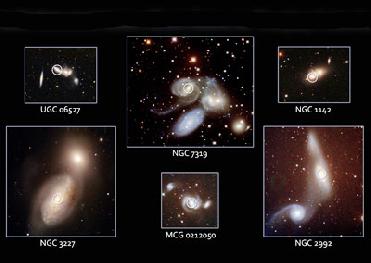
Caption: The optical counterparts of many active galactic nuclei detected by the Swift BAT Hard X-ray Survey clearly show galaxies in the process of merging. A NASA photo

WASHINGTON (BNS): NASA's Swift satellite has detected dozens of new active galactic nuclei in distant galaxies which have solved the puzzle – why only a fraction of supermassive black holes emit vast amounts of energy.
As per the latest findings, black holes “light up†when galaxies collide. Intense emissions arising out of such violent collisions give way to active galactic nuclei (AGN) which appear near the supermassive black holes, as a result of which the black holes radiate huge chunk of energy.
According to researchers, only about one percent of supermassive black holes exhibit such behaviour.
Some of the AGNs, shedding as much as 10 billion times the sun's energy, become the most luminous objects of the Universe. They include quasars and blazars.
“Theorists have shown that the violence in galaxy mergers can feed a galaxy's central black hole. The study elegantly explains how the black holes switched on,†said Michael Koss, the study's lead author and a graduate student at the University of Maryland in College Park.
The study will appear in the June 20 issue of The Astrophysical Journal Letters.
While it is difficult to detect the AGNs using soft X-ray light, the Burst Alert Telescope (BAT) aboard Swift has been mapping the sky using hard X-rays since 2004. As a result, it has found dozens of new AGN as far as 650 million light-years away.
“The Swift BAT survey is giving us a very different picture of AGN,†Koss said.
The team finds that about a quarter of the BAT galaxies are in mergers or close pairs. “Perhaps 60 percent of these galaxies will completely merge in the next billion years. We think we have the ‘smoking gun' for merger-triggered AGN that theorists have predicted,†the researcher said.
As per the latest findings, black holes “light up†when galaxies collide. Intense emissions arising out of such violent collisions give way to active galactic nuclei (AGN) which appear near the supermassive black holes, as a result of which the black holes radiate huge chunk of energy.
According to researchers, only about one percent of supermassive black holes exhibit such behaviour.
Some of the AGNs, shedding as much as 10 billion times the sun's energy, become the most luminous objects of the Universe. They include quasars and blazars.
“Theorists have shown that the violence in galaxy mergers can feed a galaxy's central black hole. The study elegantly explains how the black holes switched on,†said Michael Koss, the study's lead author and a graduate student at the University of Maryland in College Park.
The study will appear in the June 20 issue of The Astrophysical Journal Letters.
While it is difficult to detect the AGNs using soft X-ray light, the Burst Alert Telescope (BAT) aboard Swift has been mapping the sky using hard X-rays since 2004. As a result, it has found dozens of new AGN as far as 650 million light-years away.
“The Swift BAT survey is giving us a very different picture of AGN,†Koss said.
The team finds that about a quarter of the BAT galaxies are in mergers or close pairs. “Perhaps 60 percent of these galaxies will completely merge in the next billion years. We think we have the ‘smoking gun' for merger-triggered AGN that theorists have predicted,†the researcher said.