A giant comet that struck Earth 13k years ago
A giant comet, undergoing the process of disintegration, hit the Earth in 11,000 BC, resulting in catastrophic consequences in North America.


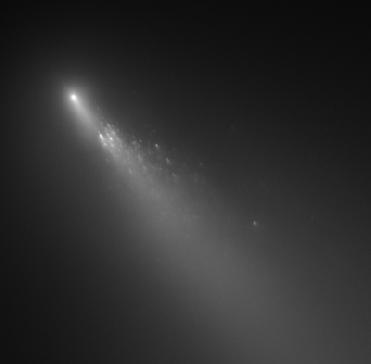
Caption: The comet's disintegration as captured by NASA's Hubble telescope. A Hubble Photo

LONDON (BNS): A giant comet undergoing disintegration process hit the Earth some 13,000 years ago, resulting in dramatic cooling of the planet and brining catastrophic changes in North America, an astronomer has said.
The Earth was struck by thousands of Tunguska-sized cometary fragments in 11,000 BC, bringing down its temperature to 8 degree Celsius and interrupting warming that was occurring at the end of the last ice age, according to Professor Bill Napier of the Cardiff University Astrobiology Centre.
The cooling lasted for over a thousand years and its onset coincided with the extinction of 35 group of North American mammals, the scientist said who has prepared a model that accounts for the major features of the catastrophe.
As per Napier's model, the Earth ran into a dense trail of material from a large disintegrating comet. He says that the comet entered the inner planetary system between 20,000 and 30,000 years ago and has been fragmenting ever since, giving rise to a number of closely related meteor streams and asteroids known as the 'Taurid Complex.'
In the course of the giant comet's disintegration, the environment of the interplanetary system would have been hazardous and the Earth would probably have run through at least one dense swarm of cometary material.
The model indicates that such an encounter would last for about an hour during which thousands of impacts would take place over continental dimensions, each releasing the energy of a megaton-class nuclear bomb, triggering extensive wildfires which took place at that time and producing microscopic hexagonal diamonds.
Explains Napier: "A large comet has been disintegrating in the near-Earth environment for the past 20,000 to 30,000 years, and running into thousands of fragments from this comet is a much more likely event than a single large collision. It gives a convincing match to the major geophysical features at this boundary."
The findings appear in the Monthly Notices of the Royal Astronomical Society.
The Earth was struck by thousands of Tunguska-sized cometary fragments in 11,000 BC, bringing down its temperature to 8 degree Celsius and interrupting warming that was occurring at the end of the last ice age, according to Professor Bill Napier of the Cardiff University Astrobiology Centre.
The cooling lasted for over a thousand years and its onset coincided with the extinction of 35 group of North American mammals, the scientist said who has prepared a model that accounts for the major features of the catastrophe.
As per Napier's model, the Earth ran into a dense trail of material from a large disintegrating comet. He says that the comet entered the inner planetary system between 20,000 and 30,000 years ago and has been fragmenting ever since, giving rise to a number of closely related meteor streams and asteroids known as the 'Taurid Complex.'
In the course of the giant comet's disintegration, the environment of the interplanetary system would have been hazardous and the Earth would probably have run through at least one dense swarm of cometary material.
The model indicates that such an encounter would last for about an hour during which thousands of impacts would take place over continental dimensions, each releasing the energy of a megaton-class nuclear bomb, triggering extensive wildfires which took place at that time and producing microscopic hexagonal diamonds.
Explains Napier: "A large comet has been disintegrating in the near-Earth environment for the past 20,000 to 30,000 years, and running into thousands of fragments from this comet is a much more likely event than a single large collision. It gives a convincing match to the major geophysical features at this boundary."
The findings appear in the Monthly Notices of the Royal Astronomical Society.