Astronomers discover largest star on record
The newly discovered star, designated R136a1, was discovered in the R136 star cluster and is the most massive star ever found.


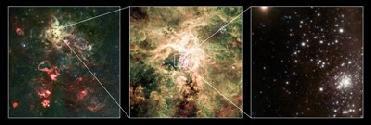
Caption: This montage shows a visible-light image of the Tarantula nebula as seen with the Wide Field Imager on the MPG/ESO 2.2-metre telescope (left) along with a zoomed-in visible-light image from the Very Large Telescope (middle). A new image of the R136 cluster, obtained with the near-infrared MAD adaptive optics instrument on the Very Large Telescope is shown in the right-hand panel, with the cluster itself at the lower right. Photo: ESO/P. Crowther/C.J. Evans
CHILE (BNS): European astronomers have recently discovered the largest star on record which is approximately 300 times the mass of the sun, beyond the previously accepted limit of 150 solar masses.
Paul Crowther, professor of Astrophysics at the University of Sheffield, led the team of researchers that discovered the star. The team used the ESO's Very Large Telescope (VLT) in Chile, and data archived from the Hubble Space Telescope.
The newly discovered star, designated R136a1, was discovered in the R136 star cluster. It is the most massive star ever found, with a current mass of about 265 solar masses and with a birthweight of as much as 320 times that of the Sun.
"Unlike humans, these stars are born heavy and lose weight as they age. Being a little over a million years old, the most extreme star R136a1 is already ‘middle-aged’ and has undergone an intense weight loss programme, shedding a fifth of its initial mass over that time, or more than fifty solar masses," Paul Crowther was quoted as saying in a news report by the European Southern Observatory (ESO).
The team also estimated the maximum possible mass for the stars within these clusters and the relative number of the most massive ones.
"Our new finding supports the previous view that there is also an upper limit to how big stars can get, although it raises the limit by a factor of two, to about 300 solar masses," added team member Olivier Schnurr from the Astrophysikalisches Institut Potsdam.
The R136 star cluster, the star's location, is in the Tarantula nebula in the Large Magellanic Cloud, a neighbouring galaxy about 165,000 light-years away. The Large Magellanic Cloud, located between the constellations Dorado and Mensa, is visible as a faint cloud in the southern hemisphere. Astronomers are still struggling to understand how these stars form.
Paul Crowther, professor of Astrophysics at the University of Sheffield, led the team of researchers that discovered the star. The team used the ESO's Very Large Telescope (VLT) in Chile, and data archived from the Hubble Space Telescope.
The newly discovered star, designated R136a1, was discovered in the R136 star cluster. It is the most massive star ever found, with a current mass of about 265 solar masses and with a birthweight of as much as 320 times that of the Sun.
"Unlike humans, these stars are born heavy and lose weight as they age. Being a little over a million years old, the most extreme star R136a1 is already ‘middle-aged’ and has undergone an intense weight loss programme, shedding a fifth of its initial mass over that time, or more than fifty solar masses," Paul Crowther was quoted as saying in a news report by the European Southern Observatory (ESO).
The team also estimated the maximum possible mass for the stars within these clusters and the relative number of the most massive ones.
"Our new finding supports the previous view that there is also an upper limit to how big stars can get, although it raises the limit by a factor of two, to about 300 solar masses," added team member Olivier Schnurr from the Astrophysikalisches Institut Potsdam.
The R136 star cluster, the star's location, is in the Tarantula nebula in the Large Magellanic Cloud, a neighbouring galaxy about 165,000 light-years away. The Large Magellanic Cloud, located between the constellations Dorado and Mensa, is visible as a faint cloud in the southern hemisphere. Astronomers are still struggling to understand how these stars form.