NASA sends aircraft to track Hayabusa's Earth entry
The DC-8 Airborne Science Laboratory aircraft carrying space scientists from US and Japan has flown to study the meteor-like plunge of Japan’s Hayabusa spacecraft.


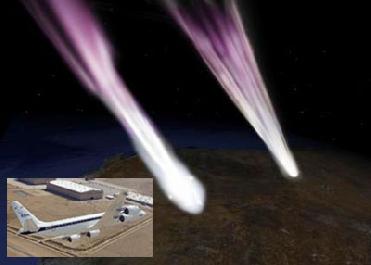
Caption: An artists's concept of Hayabusa's entry into Earth. NASA's DC-8 aircraft (inset) will track the event. A NASA Photo
Credit 10
Credit 10

PALMDALE (AP): A NASA flying observatory has left California on a mission to track a Japanese asteroid-sampling spacecraft as it returns to Earth on a course for Australia.
NASA's Dryden Flight Research Center said its DC-8 airborne lab left Palmdale Tuesday evening, carrying scientists from the US and Japanese space agencies and other organisations.
The group will study the meteor-like plunge of the Hayabusa spacecraft, which visited the asteroid Itokawa during a seven-year mission and is carrying a capsule that may contain a sample from the space rock.
The spacecraft will break up, but the capsule is targeted to land in Australia's Woomera Prohibited Area at about 1400 GMT on Sunday.
Japanese controllers overcame major problems with Hayabusa's ion engines and a loss of communications to put the craft on a return course.
NASA's Dryden Flight Research Center said its DC-8 airborne lab left Palmdale Tuesday evening, carrying scientists from the US and Japanese space agencies and other organisations.
The group will study the meteor-like plunge of the Hayabusa spacecraft, which visited the asteroid Itokawa during a seven-year mission and is carrying a capsule that may contain a sample from the space rock.
The spacecraft will break up, but the capsule is targeted to land in Australia's Woomera Prohibited Area at about 1400 GMT on Sunday.
Japanese controllers overcame major problems with Hayabusa's ion engines and a loss of communications to put the craft on a return course.