Herschel captures baby stars in the Rosette cloud
The Herschel image shows half of the nebula and most of the Rosette cloud.


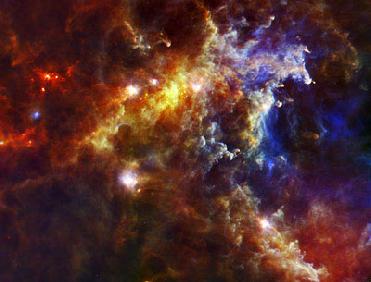
Caption: The Rosette molecular cloud, seen by Herschel. A ESA Photo.

PARIS (BNS): Herschel giant infrared observatory has captured the latest image in the Rosette molecular cloud revealing the formation of previously unseen large stars, each one up to ten times the mass of our Sun.
The Rosette Nebula resides some 5,000 light years from Earth and is associated with a larger cloud that contains enough dust and gas to make the equivalent of 10,000 Sun-like stars.
The Herschel image shows half of the nebula and most of the Rosette cloud. Each colour represents a different temperature of dust, from –263ºC (only 10ºC above absolute zero) in the red emission to –233ºC in the blue, according to a news release by ESA.
These are the stars that will influence where and how the next generation of stars are formed.
“High-mass star-forming regions are rare and further away than low-mass ones, so astronomers have had to wait for a space telescope like Herschel to reveal them,†said Frédérique Motte, Laboratoire AIM Paris-Saclay, France, as per the release.
The image captured is a combination of three infrared wavelengths, colour-coded blue, green and red. The images which are invisible to the naked eyes was created using observations from Herschel's Photoconductor Array Camera and Spectrometer (PACS) and the Spectral and Photometric Imaging Receiver (SPIRE).
‘Herschel imaging survey of OB Young Stellar objects' (HOBYS) survey targets young OB class stars, which will become the hottest and brightest stars.
In future, Herschel will look at many other high-mass star-forming regions, some of them building stars up to a hundred times the mass of the Sun.
The Rosette Nebula resides some 5,000 light years from Earth and is associated with a larger cloud that contains enough dust and gas to make the equivalent of 10,000 Sun-like stars.
The Herschel image shows half of the nebula and most of the Rosette cloud. Each colour represents a different temperature of dust, from –263ºC (only 10ºC above absolute zero) in the red emission to –233ºC in the blue, according to a news release by ESA.
These are the stars that will influence where and how the next generation of stars are formed.
“High-mass star-forming regions are rare and further away than low-mass ones, so astronomers have had to wait for a space telescope like Herschel to reveal them,†said Frédérique Motte, Laboratoire AIM Paris-Saclay, France, as per the release.
The image captured is a combination of three infrared wavelengths, colour-coded blue, green and red. The images which are invisible to the naked eyes was created using observations from Herschel's Photoconductor Array Camera and Spectrometer (PACS) and the Spectral and Photometric Imaging Receiver (SPIRE).
‘Herschel imaging survey of OB Young Stellar objects' (HOBYS) survey targets young OB class stars, which will become the hottest and brightest stars.
In future, Herschel will look at many other high-mass star-forming regions, some of them building stars up to a hundred times the mass of the Sun.