Indian Air Force kicks off exercise 'Sahayata Setu' in Jamnagar


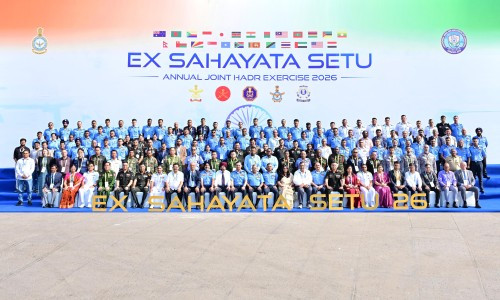
Credit PIB

The Indian Air Force on Tuesday commenced Exercise Sahayata Setu, a three-day multinational Annual Joint Humanitarian Assistance and Disaster Relief Exercise (AJHE-26), at Air Force Station Jamnagar, the Ministry of Defence announced.
Conducted under the aegis of Headquarters Integrated Defence Staff (HQ IDS) and Headquarters South Western Air Command (HQ SWAC), the exercise brings together Indian national agencies and Friendly Foreign Countries (FFCs) to strengthen coordinated disaster response.
The opening day featured a brainstorming session with representatives from nations associated with the Indian Ocean Rim Association (IORA), the Bay of Bengal Initiative for Multi-Sectoral Technical and Economic Cooperation (BIMSTEC), and the Quadrilateral Security Dialogue (QUAD).
Participating nations include Australia, Bangladesh, Comoros, Indonesia, Japan, Kenya, Madagascar, Malaysia, Maldives, Mauritius, Mozambique, Myanmar, Nepal, Oman, Seychelles, Singapore, Somalia, South Africa, Sri Lanka, Tanzania, Thailand, the United Arab Emirates, the United States, and Yemen.
Delivering the keynote address, Air Marshal PV Shivanand, Air Officer Commanding-in-Chief, South Western Air Command, spoke on the need for integrated planning, joint capability development, and seamless coordination among stakeholders. He noted these elements are vital to ensuring a swift and cohesive response to natural disasters and humanitarian emergencies.
Speakers from the Ministry of External Affairs (MEA), Indian Army, Indian Navy, IAF, National Disaster Response Force (NDRF), Defence Research and Development Organisation (DRDO), and state disaster management agencies also shared insights during discussions on “India’s Growing Global HADR Footprint.”
To illustrate India's expanding role in regional cooperation, officials presented case studies on Operation Amistad, Operation Brahma, and Operation Sagar Bandhu. Additional sessions including a QUAD working-level meeting focused on leveraging emerging technologies, improving situational awareness, and boosting interoperability during complex disaster scenarios.
Beyond tabletop discussions, the exercise is designed to familiarise foreign participants with India’s national and state-level disaster management frameworks and validate standard operating procedures.
The exercise will subsequently transition to scenario-based field drills simulating a severe cyclonic storm. These will involve reconnaissance, search and rescue, evacuation, relief operation and casualty management, followed by the activation of emergency operation centres, establishment of an incident command post, distribution of relief material and setting up of relief camps, it said.