Maritime future of Indo-Pacific cannot be shaped by any one country acting alone: Rajnath Singh


Credit PIB

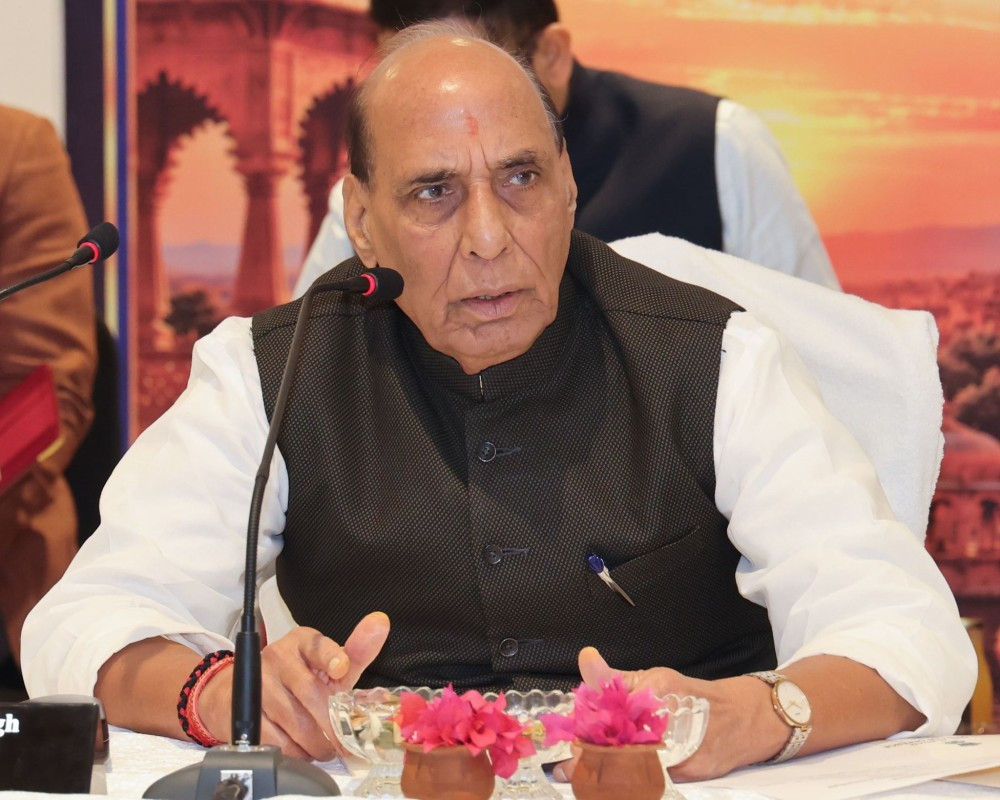
The global maritime security environment is strained by deliberate trade disruptions, and the “weaponisation” of narrow maritime passages has cast a long shadow over the broader international order, Defence Minister Rajnath Singh has said.
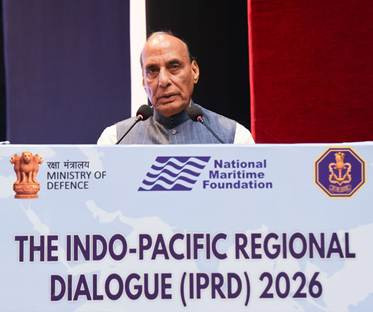
“The global maritime security environment is strained by deliberate trade disruptions. We see blatant challenges to the freedom of navigation and the weaponisation of narrow maritime passages. This growing instability in the maritime domain casts a long shadow over the broader international order,” Singh said on Wednesday, while addressing the Indo-Pacific Regional Dialogue (IPRD) – the Indian Navy’s annual apex-level international strategic conference, being held in New Delhi.
Inter-dependence among regional partners should be more secure and resilient through diversification of supply chains, reliable maritime infrastructure, enhanced maritime awareness and greater cooperation, along with the ability to anticipate, withstand and recover from disruptions, amid growing strains in the global maritime security environment, Singh said.
Describing oceans as “bridges” rather than “barriers” among nations and civilisations, he highlighted their role in sustaining livelihoods and facilitating the exchange of goods, knowledge and culture.
Despite the international community's awareness of these “universal dependencies”, certain actors and nations seek to exploit the criticality of the oceans for narrow unilateral gains, the Defence Minister said.
He asserted that the answer to the vulnerabilities of an interconnected world lies in building resilience, emphasising that globalisation cannot be abandoned in response to every disruption, nor should maritime spaces that have enabled human progress be closed.
Highlighting the evolving nature of maritime security, he said that challenges could arise not only from conventional military activities, but also from non-traditional threats such as piracy, trafficking, illegal fishing, cyber-attacks and natural disasters.
He underscored the need for maritime security to evolve with the changing maritime domain.
“Artificial intelligence is changing the way data is processed, while autonomous systems are expanding the possibilities of surveillance and operations. New sensors are improving our ability to observe the oceans. Advances in materials, biotechnology and data analytics are opening new avenues for research and application.
“These developments have enormous implications for maritime security and economic activity. But technology, by itself, is not the answer. The more important question is how we use technology to address real challenges,” Singh said.
He further added that technology must not become another “source of inequality” among nations “as the Indo-Pacific includes countries with different levels of technological and economic capability.”
“Some possess advanced research infrastructure. Others are still developing the institutional and human resources required to participate fully in this transformation. If technological progress benefits only a limited number of countries, we will not achieve the collective resilience that our region requires,” the Minister said.
He urged for promoting cooperation in research, education, innovation and capacity building, stating that a stronger scientific capability in one country can contribute to the security and prosperity of the entire region.
Terming it particularly important for smaller maritime nations and developing countries, he said the most useful technology is not necessarily the most expensive or sophisticated; it is the one that solves a real problem.
Reaffirming India's commitment to an open, inclusive and rule-based maritime order, Singh highlighted the vision of MAHASAGAR (Mutual and Holistic Advancement for Security and Growth Across Regions) that recognises the interconnected nature of security and prosperity among nations and underscores that the maritime future of the Indo-Pacific cannot be shaped by any single country acting alone.
“The future of the Indo-Pacific will not be shaped by technology alone. It will be shaped by the wisdom with which we use that technology, the partnerships we build and the confidence we create among nations,” Singh said while reiterating India's readiness to contribute to this collective endeavour.
As India moves towards Viksit Bharat by 2047, the maritime domain will play a crucial role in the country’s national transformation, he added.
He also termed the Indo-Pacific Oceans Initiative, announced by Prime Minister Modi in 2019, as a practical framework for advancing maritime cooperation across seven interconnected areas.
Emphasising the need to translate regional cooperation into tangible outcomes, the Defence Minister urged the participants of IPRD to move beyond identifying challenges and focus on practical action.
He pitched for stronger scientific networks, joint research, exchanges between universities and maritime institutions, and the development of affordable technological solutions to common challenges.
Stressing that the deliberations at the IPRD must lead to concrete outcomes, he said ideas emerging from the dialogue must translate into partnerships, projects and measurable outcomes.
Addressing the event, Chief of the Naval Staff (CNS) Admiral Krishna Swaminathan highlighted the interconnected nature of the oceans and the uneven distribution of scientific knowledge, research infrastructure and technological capabilities across the Indo-Pacific.
He emphasised that maritime cooperation must extend beyond equipment acquisition to building sustainable capabilities, enabling partner nations to operate, maintain, adapt and upgrade technologies.
Underscoring the need for a broader and more integrated approach to maritime challenges, the CNS called for greater collective investment in ocean science and research, enhanced sharing of scientific data and technology, and collaborative research initiatives, including joint scientific expeditions.
He also highlighted the importance of strengthening existing regional institutions and mechanisms through “trust, transparency and inclusive ocean governance”.
The CNS observed that IPRD-2026 provides an important platform for translating shared maritime interests into practical outcomes and generating concrete, forward-looking recommendations to strengthen science, technology and academic cooperation across the Indo-Pacific.
Other dignitaries present druing the event were Chief of the Army Staff General Dhiraj Seth, Chief of the Air Staff Air Chief Marshal Ashutosh Dixit, former CNS and Chairman, NMF Admiral Dinesh K Tripathi (Retd).
The three-day IPRD 2026, being conducted by Indian Navy in association with the National Maritime Foundation (NMF), commenced on Nov 3, 2026.