ESA's Johannes Kepler spacecraft launch delayed
An European rocket poised to lift a 20-tonne automated supply ship into space was delayed minutes before scheduled lift off when a red warning light indicated a problem the fueling system.


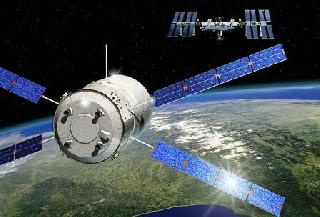
Caption: Artist's view of ESA's ATV Johannes Kepler

KOUROU, FRENCH GUIANA (AFP): An European rocket poised to lift a 20-tonne automated supply ship into space was delayed minutes before scheduled lift off, launch operator Arianespace said.
The Ariane 5 mission was to have hoisted the European Space Agency's second Automated Transfer Vehicle Tuesday toward a rendezvous with the International Space Station (ISS).
Another attempt will likely be made Wednesday, Arianespace Chairman Jean-Yves Le Gall said from the launch site in Kourou, French Guiana, via an Internet videocast immediately after the aborted lift-off.
"There's a 90-per cent chance we'll try again tomorrow," Le Gall later told journalists.
The mission was halted when a red warning light indicated a problem the fueling system.
Designed to supply mankind's nearly 400-tonne outpost in orbit, the Johannes Kepler -- the largest payload ever taken aloft by the ESA -- will bring water, air, food, spare parts and experimental hardware to the ISS.
If successful, the launch will be the 200th in the European space programme.
The Ariane 5 mission was to have hoisted the European Space Agency's second Automated Transfer Vehicle Tuesday toward a rendezvous with the International Space Station (ISS).
Another attempt will likely be made Wednesday, Arianespace Chairman Jean-Yves Le Gall said from the launch site in Kourou, French Guiana, via an Internet videocast immediately after the aborted lift-off.
"There's a 90-per cent chance we'll try again tomorrow," Le Gall later told journalists.
The mission was halted when a red warning light indicated a problem the fueling system.
Designed to supply mankind's nearly 400-tonne outpost in orbit, the Johannes Kepler -- the largest payload ever taken aloft by the ESA -- will bring water, air, food, spare parts and experimental hardware to the ISS.
If successful, the launch will be the 200th in the European space programme.