Winds foil NASA's plan to launch 'flying saucer'
The US space agency is regrouping after it lost the chance to launch a "flying saucer" into Earth's atmosphere to test Mars technology.


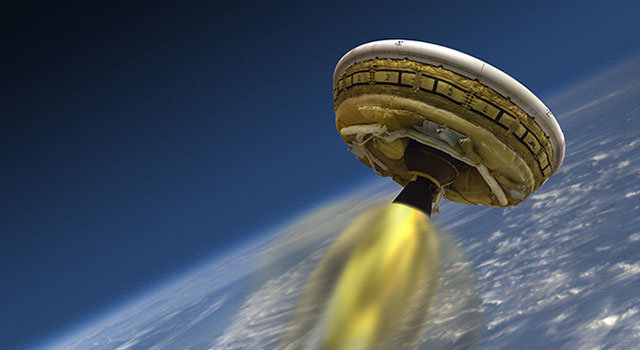
Caption: This artist's concept shows the test vehicle for NASA's Low-Density Supersonic Decelerator (LDSD), designed to test landing technologies for future Mars missions. Image credit: NASA/JPL-Caltech

LOS ANGELES (AP): The US space agency is regrouping after it lost the chance to launch a "flying saucer" into Earth's atmosphere to test Mars technology.
Winds at a military range on the Hawaiian island of Kauai have not cooperated during the two-week launch window that ends on Saturday.
NASA says winds need to be calm for a helium balloon to carry the disc-shaped vehicle over the Pacific so that it doesn't stray into no-fly zones.
The mission will test a novel vehicle and giant parachute designed to land heavy payloads on Mars, where the thin atmosphere presents challenges in slowing a spacecraft to a safe touchdown speed.
NASA has invested USD 150 million in the project. It will study its options including extending the launch window, which would be an added cost.
Winds at a military range on the Hawaiian island of Kauai have not cooperated during the two-week launch window that ends on Saturday.
NASA says winds need to be calm for a helium balloon to carry the disc-shaped vehicle over the Pacific so that it doesn't stray into no-fly zones.
The mission will test a novel vehicle and giant parachute designed to land heavy payloads on Mars, where the thin atmosphere presents challenges in slowing a spacecraft to a safe touchdown speed.
NASA has invested USD 150 million in the project. It will study its options including extending the launch window, which would be an added cost.