Chandra zooms in on Rosette star formation region
After studying one cluster in the region, scientists have found the number of young stars has gone up from 36 to about 160.


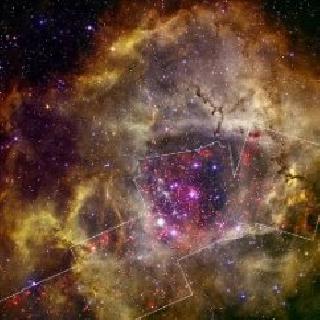
Caption: The Rosette star formation region as viewed by Chandra X-Ray Observatory. A NASA photo

WASHINGTON (BNS): NASA’s Chandra X-ray Observatory has zoomed in on the Rosette star formation region, located about 5,000 light years from Earth, in the Milky Way galaxy.
The image acquired by Chandra shows the central cluster of the region as a breeding ground for hundreds of young stars. There are fainter clusters on either side of it.
Studying one such cluster on the right side of the image, scientists have found that the number of young stars in this region has gone up from the previous count of 36 to about 160.
The presence of several X-ray emitting stars around the pillars and the detection of an outflow –commonly associated with very young stars – originating from a dark area of the optical image indicates that star formation is continuing in NGC 2237, NASA said.
By combining these results with earlier studies, the scientists conclude that the central cluster formed first, followed by expansion of the nebula, which triggered the formation of the two neighbouring clusters, including NGC 2237.
The image acquired by Chandra shows the central cluster of the region as a breeding ground for hundreds of young stars. There are fainter clusters on either side of it.
Studying one such cluster on the right side of the image, scientists have found that the number of young stars in this region has gone up from the previous count of 36 to about 160.
The presence of several X-ray emitting stars around the pillars and the detection of an outflow –commonly associated with very young stars – originating from a dark area of the optical image indicates that star formation is continuing in NGC 2237, NASA said.
By combining these results with earlier studies, the scientists conclude that the central cluster formed first, followed by expansion of the nebula, which triggered the formation of the two neighbouring clusters, including NGC 2237.