Astronomers discover an actively forming luminous ‘Blue Straggler Star’


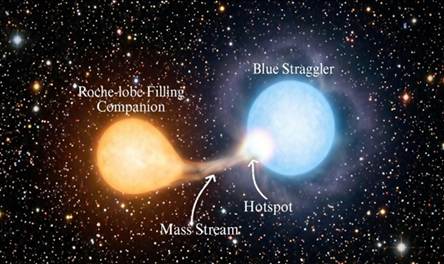
Credit PIB/ Ministry of Science & Technology

Astronomers from the Indian Institute of Astrophysics (IIA), along with their international collaborators, have discovered a rare ‘Blue Straggler Star’ caught in the act of formation, providing direct evidence of how such stars are created.
Blue Straggler Stars (BSS) are a peculiar class of stars found in star clusters that appear hotter, brighter, and more massive than their peers. Such stars have long puzzled astronomers seeking to understand their origin and evolution.
The most widely accepted explanation is that these stars gain mass from a companion or through stellar mergers, effectively rejuvenating themselves. Yet, direct observational evidence of such formation processes has remained extremely rare.
To investigate this, Indian astronomers from IIA – an autonomous institute of the Department of Science and Technology – studied a remarkable binary star system - TIC 327546480 - in the old open star cluster Collinder 261, located about 9,500 light-years away.
The binary star system was identified as a promising candidate for further investigation since its properties suggested ongoing interaction between the two stars.
The study combined high-precision light curves from NASA's TESS space mission with radial velocity measurements obtained using the Very Large Telescope operated by the European Southern Observatory in Chile.
“We discovered that the Blue Straggler is actively gaining material from its companion star, providing a rare glimpse of a BSS caught in the act of formation. Our finding offers direct observational evidence for one of the leading theories proposed to explain the origin of BSSs”, explained Annapurni Subramaniam, faculty member at the IIA, and a co-author of the study.
They found the binary system to be “semi-detached”, meaning that one of the two stars has expanded enough to overflow its gravitational boundary, known as the ‘Roche lobe’, thereby causing the less massive companion star to transfer matter to the BSS.
This ongoing mass transfer from the less massive companion to the BSS confirms that the rejuvenation process is still taking place, making the system one of the clearest examples of a forming blue straggler identified so far, the astronomers noted.
The researchers also detected strong X-ray emission from the system. Such X-ray activity is expected when material transferred from the companion is being accreted by the BSS, providing independent evidence that mass transfer is currently ongoing.
“Detailed analysis showed that the BSS has a mass of about 1.67 times that of the Sun and is accreting matter from a companion with a mass of about 0.32 solar mass,” according to Ali Hasan Sheikh, a Ph.D. student at the Gauhati University and the first author of the study.
The binary has an orbital period of 2.11 days, a low mass ratio of approximately 0.19, and the BSS rotates rapidly at about 69.55 km/s, likely spun up by the accreted material, he said.
Evolutionary modelling suggests that mass transfer began around 5.46 billion years ago and continues to the present day, while the cluster itself is estimated to be about 7 billion years old.
“This discovery provides one of the strongest pieces of direct observational evidence yet for the formation of BSSs through mass transfer in binary systems, helping to resolve a decades-old mystery in stellar astrophysics,” explained Ram Sagar, faculty member at IIA, and one of the co-authors of the study.
By capturing a BSS in the act of formation, the system offers a unique laboratory for testing theories of binary evolution and stellar rejuvenation, with important implications for understanding the evolution of star clusters and interacting stars throughout the Universe.
The results of the work have been published in the Astrophysical Journal Letters, authored by Ali Hasan Sheikh, Biman J. Medhi and. Hitendra Sarkar from Gauhati University, Annapurni Subramaniam and Ram Sagar from the Indian Institute of Astrophysics, Bengaluru; Sergio Messina from the INAF Italy, Anupam Bharadwaj and. Susmita Das from the IUCAA Pune, Atila Poro from LUX Observatoire de Paris, France; and Marina Kounkel from the University of North Florida, USA, the Department of Science and Technology stated in an official release.