NASA stops listening for Phoenix Mars Lander
After nearly a month of daily checks NASA has stopped using its Mars Orbiter to listen for any beeps from the Phoenix <br />


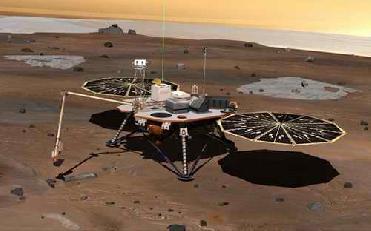
Caption: Artist's concept of Phoenix on Mars. NASA photo
Credit 10
Credit 10

WASHINGTON (BNS): After nearly a month of daily checks to determine whether Martian NASA's Phoenix Mars Lander would be able to communicate again, NASA has stopped using its Mars orbiters to hail the lander and listen for its beep.
According to the agency, as expected, reduced daily sunshine eventually left the solar-powered Phoenix craft without enough energy to keep its batteries charged.
NASA received a brief signal from the Phoenix through the Mars Odyssey orbiter on November 2, and what seems to be the last and final it would ever hear from the lander.
The Phoenix lander operated for two overtime months after achieving its science goals during its original three-month mission. It landed on a Martian arctic plain on May 25.
"The variability of the Martian weather was a contributing factor to our loss of communications, and we were hoping that another variation in weather might give us an opportunity to contact the lander again," said Phoenix Mission Manager Chris Lewicki of NASA's Jet Propulsion Laboratory, in Pasadena, California.
The end of efforts to listen for Phoenix with Odyssey and NASA's Mars Reconnaissance Orbiter had been planned for the start of solar conjunction, when communications between Earth and Mars-orbiting spacecraft are minimized for a few week. That period, when the sun is close to the line between Earth and Mars, has begun and will last until mid-December.
The last attempt to listen for a signal from Phoenix was when Odyssey passed overhead at 3:49 pm PST Saturday, November 29 (4:26 p.m. local Mars solar time on the 182nd Martian day, or sol, since Phoenix landed).
According to NASA, November 29 was selected weeks ago as the final date for relay monitoring of Phoenix because it provided several weeks to the chance to confirm the fate of the lander, and it coincided with the beginning of solar conjunction operations for the orbiters.
“When they come out of the conjunction period, weather on far-northern Mars will be far colder, and the declining sunshine will have ruled out any chance of hearing from Phoenix,†NASA said.
According to the agency, as expected, reduced daily sunshine eventually left the solar-powered Phoenix craft without enough energy to keep its batteries charged.
NASA received a brief signal from the Phoenix through the Mars Odyssey orbiter on November 2, and what seems to be the last and final it would ever hear from the lander.
The Phoenix lander operated for two overtime months after achieving its science goals during its original three-month mission. It landed on a Martian arctic plain on May 25.
"The variability of the Martian weather was a contributing factor to our loss of communications, and we were hoping that another variation in weather might give us an opportunity to contact the lander again," said Phoenix Mission Manager Chris Lewicki of NASA's Jet Propulsion Laboratory, in Pasadena, California.
The end of efforts to listen for Phoenix with Odyssey and NASA's Mars Reconnaissance Orbiter had been planned for the start of solar conjunction, when communications between Earth and Mars-orbiting spacecraft are minimized for a few week. That period, when the sun is close to the line between Earth and Mars, has begun and will last until mid-December.
The last attempt to listen for a signal from Phoenix was when Odyssey passed overhead at 3:49 pm PST Saturday, November 29 (4:26 p.m. local Mars solar time on the 182nd Martian day, or sol, since Phoenix landed).
According to NASA, November 29 was selected weeks ago as the final date for relay monitoring of Phoenix because it provided several weeks to the chance to confirm the fate of the lander, and it coincided with the beginning of solar conjunction operations for the orbiters.
“When they come out of the conjunction period, weather on far-northern Mars will be far colder, and the declining sunshine will have ruled out any chance of hearing from Phoenix,†NASA said.