Chandrayaan-1 sends first pictures
The spacecraft which is now circling Earth, tested its camera through a series of command from Bangalore facility and sent out its first images


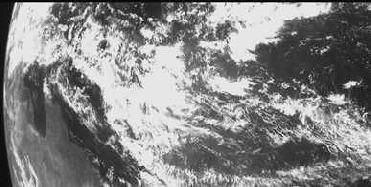
Caption: Earth as captured by the Terrrain Mapping Camera October 29. ISRO photo
Credit 10
Credit 10

BANGALORE (BNS): Chandrayaan nearing destination moon, flashed its first imagery on October 29, confirming the excellent performance of the Terrain Mapping camera.
The spacecraft is now circling the Earth in an orbit whose apogee (farthest point to Earth) lies at 267,000 km (Two lakh sixty seven thousand km) and perigee (nearest point to Earth) at 465 km. In this orbit, Chandrayaan-1 takes about six days to go round the Earth once.
“The spacecraft performance is being continuously monitored and is normal,†Indian Space Research Organisation (ISRO) said.
“The camera was successfully operated through a series of commands issued from the Spacecraft Control Centre of ISRO Telemetry, Tracking and Command Network (ISTRAC) at Bangalore,†ISRO said Friday.
“Analysis of the first imagery received by the Indian Deep Space Network (IDSN) at Byalalu and later processed by Indian Space Science Data Centre (ISSDC) confirms excellent performance of the camera,†the Indian space agency said.
The first imagery (image 1) taken at 8.00 am IST from a height of 9,000 km shows the Northern coast of Australia while the other (image 2) taken at 12:30 pm from a height of 70,000 km shows Australia's Southern Coast.
TMC is one of the eleven scientific instruments (payloads) of Chandrayaan-1. The camera can take black and white pictures of an object by recording the visible light reflected from it. The instrument has a resolution of about five metres.
Besides TMC, the other four Indian payloads of Chandrayaan-1 are the Hyper spectral Imager (HySI), Lunar Laser Ranging Instrument (LLRI), High Energy X-ray Spectrometer (HEX) and the Moon Impact Probe (MIP). The other six payloads of Chandrayaan-1 are from abroad.
The 1380 kg Chandrayaan-1 was successfully launched into an initial elliptical orbit around the Earth by PSLV-C11 on October 22, 2008. This was followed by four orbit raising manoeuvres, which together raised Chandrayaan-1's orbit to a much higher altitude.
The spacecraft is now circling the Earth in an orbit whose apogee (farthest point to Earth) lies at 267,000 km (Two lakh sixty seven thousand km) and perigee (nearest point to Earth) at 465 km. In this orbit, Chandrayaan-1 takes about six days to go round the Earth once.
“The spacecraft performance is being continuously monitored and is normal,†Indian Space Research Organisation (ISRO) said.
“The camera was successfully operated through a series of commands issued from the Spacecraft Control Centre of ISRO Telemetry, Tracking and Command Network (ISTRAC) at Bangalore,†ISRO said Friday.
“Analysis of the first imagery received by the Indian Deep Space Network (IDSN) at Byalalu and later processed by Indian Space Science Data Centre (ISSDC) confirms excellent performance of the camera,†the Indian space agency said.
The first imagery (image 1) taken at 8.00 am IST from a height of 9,000 km shows the Northern coast of Australia while the other (image 2) taken at 12:30 pm from a height of 70,000 km shows Australia's Southern Coast.
TMC is one of the eleven scientific instruments (payloads) of Chandrayaan-1. The camera can take black and white pictures of an object by recording the visible light reflected from it. The instrument has a resolution of about five metres.
Besides TMC, the other four Indian payloads of Chandrayaan-1 are the Hyper spectral Imager (HySI), Lunar Laser Ranging Instrument (LLRI), High Energy X-ray Spectrometer (HEX) and the Moon Impact Probe (MIP). The other six payloads of Chandrayaan-1 are from abroad.
The 1380 kg Chandrayaan-1 was successfully launched into an initial elliptical orbit around the Earth by PSLV-C11 on October 22, 2008. This was followed by four orbit raising manoeuvres, which together raised Chandrayaan-1's orbit to a much higher altitude.