New mineral discovery reveals a wetter past on Mars
Opaline silica tells us that water may have existed as recently as two billion years ago and played an important role in shaping life on the Red Planet's surface, say NASA scientists


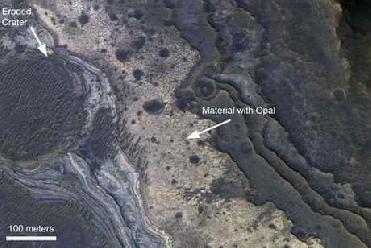
Caption: NASA's Mars Reconnaissance Orbiter has revealed Martian rocks containing a hydrated mineral similar to opal. The image was taken by the High Resolution Imaging Science Experiment camera. NASA Photo
Credit 10
Credit 10

WASHINGTON (BNS): NASA's Mars Reconnaissance Orbiter has made a startling discovery of minerals spread across large regions of Mars. This discovery suggests that liquid water remained on the planet's surface a billion years later than scientists believed, and it played an important role in shaping the planet's surface and possibly hosting life.
Scientists examining data from the Mars orbiter's Compact Reconnaissance Imaging Spectrometer have found the existence of hydrated silica, popularly called opal. The hydrated, or water-containing, mineral deposits are telltale signs of where and when water was present on ancient Mars, the scientists said.
"This is an exciting discovery because it extends the time range for liquid water on Mars, and the places where it might have supported life," said Scott Murchie, the spectrometer's principal investigator at the Johns Hopkins University Applied Physics Laboratory in Laurel, Md. "The identification of opaline silica tells us that water may have existed as recently as 2 billion years ago."
Until now, the spacecraft orbiting Mars had observed only two major groups of hydrated minerals, phyllosilicates and hydrated sulphates. Clay-like phyllosilicates formed more than 3.5 billion years ago where igneous rock came into long-term contact with water. During the next several hundred million years, until approximately 3 billion years ago, hydrated sulphates formed from the evaporation of salty and sometimes acidic water.
The newly discovered opaline silicates are the youngest of the three types of hydrated minerals. They formed where liquid water altered materials created by volcanic activity or meteorite impact on the Martian surface. One such location noted by scientists is the large Martian canyon system called Valles Marineris.
“We see numerous outcrops of opal-like minerals, commonly in thin layers extending for very long distances around the rim of Valles Marineris and sometimes within the canyon system itself,†said Ralph Milliken of NASA's Jet Propulsion Laboratory in Pasadena, California.
Milliken, who is the lead author of an article published in the November issue of ‘Geology' describes the identification of opaline silica. He said the minerals, which were also found in Gusev Crater recently by NASA's Mars rover Spirit, are widespread and occur in relatively young terrains.
"What's important is that the longer liquid water existed on Mars, the longer the window during which Mars may have supported life," says Milliken, “The opaline silica deposits would be good places to explore to assess the potential for habitability on Mars, especially in these younger terrains.â€Â
Scientists examining data from the Mars orbiter's Compact Reconnaissance Imaging Spectrometer have found the existence of hydrated silica, popularly called opal. The hydrated, or water-containing, mineral deposits are telltale signs of where and when water was present on ancient Mars, the scientists said.
"This is an exciting discovery because it extends the time range for liquid water on Mars, and the places where it might have supported life," said Scott Murchie, the spectrometer's principal investigator at the Johns Hopkins University Applied Physics Laboratory in Laurel, Md. "The identification of opaline silica tells us that water may have existed as recently as 2 billion years ago."
Until now, the spacecraft orbiting Mars had observed only two major groups of hydrated minerals, phyllosilicates and hydrated sulphates. Clay-like phyllosilicates formed more than 3.5 billion years ago where igneous rock came into long-term contact with water. During the next several hundred million years, until approximately 3 billion years ago, hydrated sulphates formed from the evaporation of salty and sometimes acidic water.
The newly discovered opaline silicates are the youngest of the three types of hydrated minerals. They formed where liquid water altered materials created by volcanic activity or meteorite impact on the Martian surface. One such location noted by scientists is the large Martian canyon system called Valles Marineris.
“We see numerous outcrops of opal-like minerals, commonly in thin layers extending for very long distances around the rim of Valles Marineris and sometimes within the canyon system itself,†said Ralph Milliken of NASA's Jet Propulsion Laboratory in Pasadena, California.
Milliken, who is the lead author of an article published in the November issue of ‘Geology' describes the identification of opaline silica. He said the minerals, which were also found in Gusev Crater recently by NASA's Mars rover Spirit, are widespread and occur in relatively young terrains.
"What's important is that the longer liquid water existed on Mars, the longer the window during which Mars may have supported life," says Milliken, “The opaline silica deposits would be good places to explore to assess the potential for habitability on Mars, especially in these younger terrains.â€Â