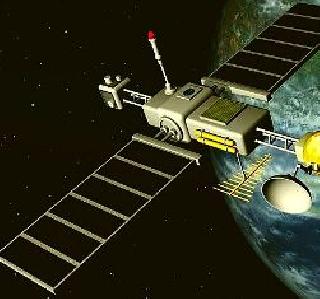
ExoMars to seek gaseous clues about possible life on Mars
The ExoMars Climate Sounder is an infrared radiometer designed to operate continuously, day and night, from the spacecraft's orbit about 400 kilometers (about 250 miles) above the Martian surface.


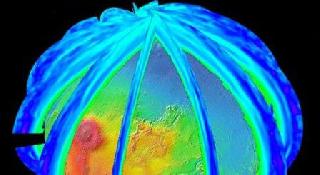
Caption: The Mars Climate Sounder instrument on NASA's Mars Reconnaissance Orbiter maps the vertical distribution of temperatures, dust, water vapour and ice clouds in the Martian atmosphere as the orbiter flies a near-polar orbit. Photo by NASA/JPL-Caltech.

PASADENA (BNS): One of the instruments on a 2016 mission to orbit Mars will provide daily maps of global, pole-to-pole, vertical distributions of the temperature, dust, water vapour and ice clouds in the Martian atmosphere.
The joint European-American mission, ExoMars Trace Gas Orbiter, will seek faint gaseous clues about possible life on Mars. This instrument, called the ExoMars Climate Sounder, will supply crucial context with its daily profiling of the atmosphere's changing structure, a NASA statement said.
Five instruments have been selected for ExoMars Trace Gas Orbiter - ESA will provide one instrument and the spacecraft and NASA four instruments, including ExoMars Climate Sounder, which is coming from NASA's Jet Propulsion Laboratory.
Two of the other selected instruments are spectrometers -- one each from Europe and the United States -- designed to detect very low concentrations of methane and other important trace gases in the Martian atmosphere.
"To put the trace-gas measurements into context, you need to know the background structure and circulation of the atmosphere," said JPL's Tim Schofield, principal investigator for the ExoMars Climate Sounder.
"We will provide the information needed to understand the distribution of trace gases identified by the spectrometers. We'll do this by characterizing the role of atmospheric circulation and aerosols, such as dust and ice, in trace-gas transport and in chemical reactions in the atmosphere affecting trace gases."
The ExoMars Climate Sounder is an infrared radiometer designed to operate continuously, day and night, from the spacecraft's orbit about 400 kilometers (about 250 miles) above the Martian surface.
It can pivot to point downward or toward the horizon, measuring temperature, water vapour, dust and ices for each 5-kilometer (3-mile) increment in height throughout the atmosphere from ground level to 90 kilometers (56 miles) altitude.
The 2016 ExoMars Trace Gas Orbiter is the first in a series of planned Mars mission collaborations of ESA and NASA. A variable presence of small amounts of methane in the Martian atmosphere has been indicated from orbital and Earth-based observations.
A key goal of the mission is to gain a better understanding of methane and other trace gases that could be evidence about possible biological activity. Methane can be produced both biologically and without life.
The joint European-American mission, ExoMars Trace Gas Orbiter, will seek faint gaseous clues about possible life on Mars. This instrument, called the ExoMars Climate Sounder, will supply crucial context with its daily profiling of the atmosphere's changing structure, a NASA statement said.
Five instruments have been selected for ExoMars Trace Gas Orbiter - ESA will provide one instrument and the spacecraft and NASA four instruments, including ExoMars Climate Sounder, which is coming from NASA's Jet Propulsion Laboratory.
Two of the other selected instruments are spectrometers -- one each from Europe and the United States -- designed to detect very low concentrations of methane and other important trace gases in the Martian atmosphere.
"To put the trace-gas measurements into context, you need to know the background structure and circulation of the atmosphere," said JPL's Tim Schofield, principal investigator for the ExoMars Climate Sounder.
"We will provide the information needed to understand the distribution of trace gases identified by the spectrometers. We'll do this by characterizing the role of atmospheric circulation and aerosols, such as dust and ice, in trace-gas transport and in chemical reactions in the atmosphere affecting trace gases."
The ExoMars Climate Sounder is an infrared radiometer designed to operate continuously, day and night, from the spacecraft's orbit about 400 kilometers (about 250 miles) above the Martian surface.
It can pivot to point downward or toward the horizon, measuring temperature, water vapour, dust and ices for each 5-kilometer (3-mile) increment in height throughout the atmosphere from ground level to 90 kilometers (56 miles) altitude.
The 2016 ExoMars Trace Gas Orbiter is the first in a series of planned Mars mission collaborations of ESA and NASA. A variable presence of small amounts of methane in the Martian atmosphere has been indicated from orbital and Earth-based observations.
A key goal of the mission is to gain a better understanding of methane and other trace gases that could be evidence about possible biological activity. Methane can be produced both biologically and without life.