IAF, Astrophysicists conduct the Solar eclipse experiment‎
The eclipse began Wednesday morning at 5:28 hours when the shadow of the moon touched the Earth at a point in the Arabian Sea close to the western coast of India


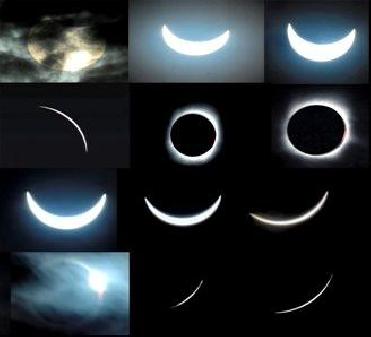
Caption: A slide view of the different phases of solar eclipse as observed from Baihata about 30 kms from Guwahati on Wednesday. Image Credit: PTI

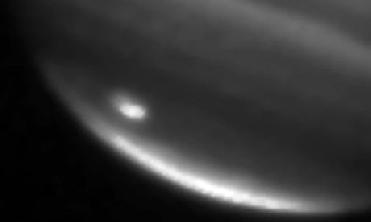
NEW DELHI (PTI): Solar eclipse trackers on the ground were not be the only ones studying the spectacle as the IAF and astrophysicists also conducted experiments and taken photos of the celestial event from a fighter jet and a transport aircraft.
The eclipse began Wednesday morning at 5:28 hours when the shadow of the moon touched the Earth at a point in the Arabian Sea close to the western coast of India.
The eclipse ended at l0:42 hours when Moon's shadow finally left the Earth at a point in the South Pacific Ocean.
At approximately 6:23 Hours, the umbra of the eclipse touched the earth at sunrise at a point in the Gulf of Khambhat in the Arabian Sea near the southern coast of Gujarat.
A Mirage-2000 fighter jet and an AN-32 medium lift transport aircraft were flown by IAF pilots to assist scientists from Vigyan Prasar, an autonomous body of the Department of Science and Technology, to carry out the experiments.
Scientists from Noida-based Vigyan Prasar, Udaipur-based Solar Observatory and Bangalore-based Indian Institute of Astrophysics participated in the experiments and the filming.
This year's eclipse was visible in parts of India from Gulf of Khambhat in Gujarat in the west to Arunachal Pradesh in the east. The eclipse corridor passed close to Gwalior air base.
"This year's eclipse is significant for its long duration as also that the next eclipse will be in 2034, over Kashmir valley for a short duration over India. The total solar eclipse after that will only be in 2114," said Dr Vinay B Kamble, Vigyan Prasar Director.
The eclipse began Wednesday morning at 5:28 hours when the shadow of the moon touched the Earth at a point in the Arabian Sea close to the western coast of India.
The eclipse ended at l0:42 hours when Moon's shadow finally left the Earth at a point in the South Pacific Ocean.
At approximately 6:23 Hours, the umbra of the eclipse touched the earth at sunrise at a point in the Gulf of Khambhat in the Arabian Sea near the southern coast of Gujarat.
A Mirage-2000 fighter jet and an AN-32 medium lift transport aircraft were flown by IAF pilots to assist scientists from Vigyan Prasar, an autonomous body of the Department of Science and Technology, to carry out the experiments.
Scientists from Noida-based Vigyan Prasar, Udaipur-based Solar Observatory and Bangalore-based Indian Institute of Astrophysics participated in the experiments and the filming.
This year's eclipse was visible in parts of India from Gulf of Khambhat in Gujarat in the west to Arunachal Pradesh in the east. The eclipse corridor passed close to Gwalior air base.
"This year's eclipse is significant for its long duration as also that the next eclipse will be in 2034, over Kashmir valley for a short duration over India. The total solar eclipse after that will only be in 2114," said Dr Vinay B Kamble, Vigyan Prasar Director.