India agrees to ink End-Use Monitoring Agreement with the US
The pact will ensure smooth transfer of high-tech military hardware to India by the US which will physically inspect all such equipment


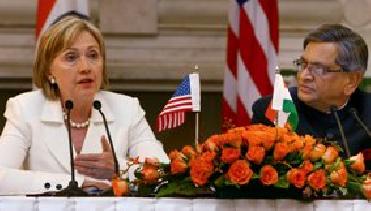
Caption: US Secretary of State Hillary Clinton addressing the media along with External Affairs Minister S M Krishna in New Delhi on Monday. -- Image credit: PTI
Credit 10
Credit 10

NEW DELHI (BNS): To ease the process of supplying high-tech military hardware to New Delhi, India and the US have agreed to ink the End-Use Monitoring Agreement (EUMA).
The pact envisages physical inspection of defence equipment and technology sold to India by the US. India will have the right to decide the time and place of such verification.
One of the clauses in the pact also ensures that the standardised text cannot be altered without joint discussion if there is any change in US laws in future.
“We have shown progress also by finalising important agreements today including the end user agreement that will pave the way for greater defence cooperation between our countries,†US Secretary of State Hillary Clinton told reporters here while addressing a joint press conference with Indian External Affairs Minister S M Krishna.
Once signed, the generic EUMA would be applicable to all future defence equipment purchases that India would make from the US. The physical monitoring clause will ensure prevention of misuse of military equipment supplied to India.
With its eyes firmly set on the lucrative Indian defence market, the US had been pushing India to sign the EUMA, which is required under its domestic laws. The EUMA governs sensitive technology control requirements to prevent its leaking to other countries.
Initially apprehensive over the “physical inspection†clause in the pact, New Delhi has finally agreed to sign the deal following acceptable legal language in the text addressing concerns of both sides, defence ministry sources said.
Once signed, the agreement will now pave the way for high-end sensors, radars and weapon systems to be fitted on the aircraft being purchased under the already-inked $2.1 billion contract for eight Boeing P-8I maritime reconnaissance planes and the $962 million one for six C-130J 'super Hercules' planes.
It will also govern all future defence deals, including the ‘big ticket' deal of procuring 126 medium multi-role combat aircraft for the IAF at a whopping $10.4-billion.
The pact envisages physical inspection of defence equipment and technology sold to India by the US. India will have the right to decide the time and place of such verification.
One of the clauses in the pact also ensures that the standardised text cannot be altered without joint discussion if there is any change in US laws in future.
“We have shown progress also by finalising important agreements today including the end user agreement that will pave the way for greater defence cooperation between our countries,†US Secretary of State Hillary Clinton told reporters here while addressing a joint press conference with Indian External Affairs Minister S M Krishna.
Once signed, the generic EUMA would be applicable to all future defence equipment purchases that India would make from the US. The physical monitoring clause will ensure prevention of misuse of military equipment supplied to India.
With its eyes firmly set on the lucrative Indian defence market, the US had been pushing India to sign the EUMA, which is required under its domestic laws. The EUMA governs sensitive technology control requirements to prevent its leaking to other countries.
Initially apprehensive over the “physical inspection†clause in the pact, New Delhi has finally agreed to sign the deal following acceptable legal language in the text addressing concerns of both sides, defence ministry sources said.
Once signed, the agreement will now pave the way for high-end sensors, radars and weapon systems to be fitted on the aircraft being purchased under the already-inked $2.1 billion contract for eight Boeing P-8I maritime reconnaissance planes and the $962 million one for six C-130J 'super Hercules' planes.
It will also govern all future defence deals, including the ‘big ticket' deal of procuring 126 medium multi-role combat aircraft for the IAF at a whopping $10.4-billion.