Herschel's first images promise bright future
Herschel has carried out the first test observations with all its instruments, with spectacular results


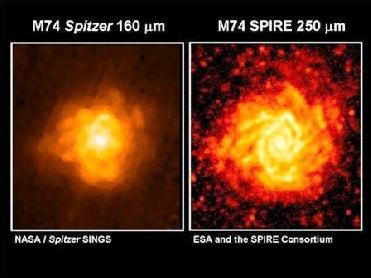
Caption: M74 (also known as NGC 628) is a face-on spiral galaxy located about 24 million light years from Earth in the constellation Pisces. The infrared SPIRE images trace the cold dust between the stars, clearly showing the galaxy's spiral structure. They also contain many faint dots that are actually distant galaxies. These galaxies contain dust that radiates at infrared wavelengths, but because they are much further away, we cannot see the structure in the galaxies. Photo Credit: ESA and the SPIRE consortium

PARIS (BNS): Herschel has carried out the first test observations with all its instruments, with spectacular results. Galaxies, star-forming regions and dying stars comprised the telescope's first targets. The instruments provided spectacular data on their first attempt, finding water and carbon and revealing dozens of distant galaxies, as reported in a release by ESA.
According to the release, these observations show that Herschel's instruments are working beyond expectations. They promise a mission of rich discoveries for waiting astronomers.
Herschel's Spectral and Photometric Imaging Receiver (SPIRE) was trained on two galaxies for its first look at the Universe. The galaxies showed up prominently, providing astronomers with their best images yet at these wavelengths, and revealing other more distant galaxies in the background of the images.
The release further stated that, SPIRE is designed to look at star formation in our own Galaxy and in nearby galaxies. It will also search for star-forming galaxies in the very distant Universe.
Scientists used Herschel's Heterodyne Instrument for the Far-Infrared (HIFI) to look for warm molecular gas heated by newborn massive stars in the DR21 star-forming region in Cygnus.
HIFI provided excellent data in two different observing modes, returning information on the composition of the region with unprecedented accuracy and resolution.
Using HIFI, scientists observed ionised carbon, carbon monoxide, and water in DR21.
With the Photodetector Array Camera and Spectrometer (PACS) instrument it is now possible for the first time to make images in spectral lines for on the sky, and see how the wind from the star shapes the nebula in three dimensions.
Following these first light images, Herschel is now in the performance verification phase, where the instruments will be further tested and calibrated.
According to the release, these observations show that Herschel's instruments are working beyond expectations. They promise a mission of rich discoveries for waiting astronomers.
Herschel's Spectral and Photometric Imaging Receiver (SPIRE) was trained on two galaxies for its first look at the Universe. The galaxies showed up prominently, providing astronomers with their best images yet at these wavelengths, and revealing other more distant galaxies in the background of the images.
The release further stated that, SPIRE is designed to look at star formation in our own Galaxy and in nearby galaxies. It will also search for star-forming galaxies in the very distant Universe.
Scientists used Herschel's Heterodyne Instrument for the Far-Infrared (HIFI) to look for warm molecular gas heated by newborn massive stars in the DR21 star-forming region in Cygnus.
HIFI provided excellent data in two different observing modes, returning information on the composition of the region with unprecedented accuracy and resolution.
Using HIFI, scientists observed ionised carbon, carbon monoxide, and water in DR21.
With the Photodetector Array Camera and Spectrometer (PACS) instrument it is now possible for the first time to make images in spectral lines for on the sky, and see how the wind from the star shapes the nebula in three dimensions.
Following these first light images, Herschel is now in the performance verification phase, where the instruments will be further tested and calibrated.