Astronomers discovered a binary star-disk system
Astronomers found a binary system 253-1536, stands out as the first known example of two optically visible stars. It lies 1,300 light-years from Earth, in the famous Orion Nebula.


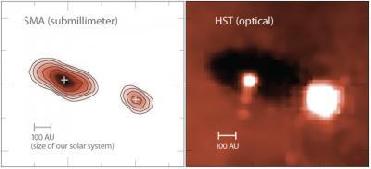
Caption: Submillimeter Array image of 253-1536 taken at a wavelength of 880 microns is in the left side, The optical image taken by the Hubble Space Telescope is on the right side.Photo Credit: University of Hawaii and Nathan Smith, University of California at Berkeley
Credit 10
Credit 10

NEW DELHI (BNS): Astronomers have found a binary star-disk system in which each star is surrounded by the kind of dust disk that is frequently the precursor of a planetary system.
According to Science Daily report, doctoral student Rita Mann and Dr. Jonathan Williams used the Sub-millimeter Array on Mauna Kea, Hawaii to make the observations. A binary star system consists of two stars bound together by gravity that orbit a common center of gravity. Most stars form as binaries, and if both stars are hospitable to planet formation, it increases the likelihood that scientists will discover Earth-like planets.
The two stars are 400 times farther from each other than Earth is from the sun. They would take 4,500 years, or about the length of human recorded history, to complete one orbit around their common center. Both stars are only about a third the mass of our sun and are much cooler and redder in color.
Viewed from a potential future planet, the stellar neighbor would appear as an intense point in the night sky, about one thousand times brighter than the brightest star in our night sky, Sirius. Planets around the other star would be visible only through telescopes, but they would be within reach of spacecraft from a civilization with the same level of technology as ours.
The larger disk in 253-1536 is also the most massive found in the Orion Nebula so far. The discovery of this massive disk and the binary disk system improve our understanding of how common planet formation is in our Galaxy and place our Solar System in context, it said.
According to Science Daily report, doctoral student Rita Mann and Dr. Jonathan Williams used the Sub-millimeter Array on Mauna Kea, Hawaii to make the observations. A binary star system consists of two stars bound together by gravity that orbit a common center of gravity. Most stars form as binaries, and if both stars are hospitable to planet formation, it increases the likelihood that scientists will discover Earth-like planets.
The two stars are 400 times farther from each other than Earth is from the sun. They would take 4,500 years, or about the length of human recorded history, to complete one orbit around their common center. Both stars are only about a third the mass of our sun and are much cooler and redder in color.
Viewed from a potential future planet, the stellar neighbor would appear as an intense point in the night sky, about one thousand times brighter than the brightest star in our night sky, Sirius. Planets around the other star would be visible only through telescopes, but they would be within reach of spacecraft from a civilization with the same level of technology as ours.
The larger disk in 253-1536 is also the most massive found in the Orion Nebula so far. The discovery of this massive disk and the binary disk system improve our understanding of how common planet formation is in our Galaxy and place our Solar System in context, it said.