Artificial black hole 'to detect Hawking radiation'
According to the theory proposed by Hawking 30 years ago, radiation causes black holes to evaporate over time.


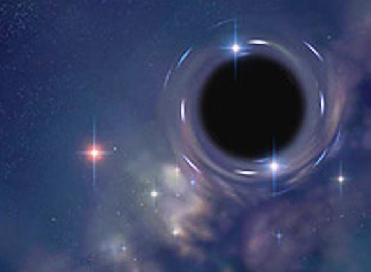
Caption: Scientists have create artificial black hole that traps sound in a bid to find out whether Hawking's radiation actually exists in theory.
Credit 10
Credit 10

LONDON (PTI): Scientists have created what they claim is an artificial black hole that traps sound in a bid to find out whether eminent physicist Stephen Hawking's radiation actually exists in theory.
According to the theory proposed by Hawking 30 years ago, radiation causes black holes to evaporate over time.
Astrophysical black holes are created when matter gets so dense that it collapses to a point called a singularity. In fact, physicists have been developing 'black holes' for sound. They do this by coaxing material to move faster than the speed of sound in that medium.
Now, a team, led by Jeff Steinhauer of Technion-Israel Institute of Technology is the first to document an experiment directly aimed at producing Hawking radiation in Bose-Einstein condensates (BEC), the 'New Scientist' reported.
The scientists cooled 100,000 or so charged rubidium atoms to a few billionths of a degree above absolute zero and trapped them with a magnetic field.
Using a laser, they then created a well of electric potential that attracted the atoms and caused them to zip across the well faster than the speed of sound in the material.
This setup created a supersonic flow that lasted for some 8 milliseconds, fleetingly forming an acoustic black hole capable of trapping sound. The implications of such work could be profound as it could lead to the first detection of Hawking radiation, according to the scientists. Quantum mechanics says that pairs of particles can spontaneously appear out of empty space. These pairs, which consist of a particle and its antiparticle, should exist for a fleeting moment before annihilating each other and disappear.
In the 1970s, Hawking proposed that if the pair was created near the edge of a black hole, one particle might fall in before it's destroyed, leaving its partner stranded outside the event horizon. To observers, this particle would appear as radiation.
According to the theory proposed by Hawking 30 years ago, radiation causes black holes to evaporate over time.
Astrophysical black holes are created when matter gets so dense that it collapses to a point called a singularity. In fact, physicists have been developing 'black holes' for sound. They do this by coaxing material to move faster than the speed of sound in that medium.
Now, a team, led by Jeff Steinhauer of Technion-Israel Institute of Technology is the first to document an experiment directly aimed at producing Hawking radiation in Bose-Einstein condensates (BEC), the 'New Scientist' reported.
The scientists cooled 100,000 or so charged rubidium atoms to a few billionths of a degree above absolute zero and trapped them with a magnetic field.
Using a laser, they then created a well of electric potential that attracted the atoms and caused them to zip across the well faster than the speed of sound in the material.
This setup created a supersonic flow that lasted for some 8 milliseconds, fleetingly forming an acoustic black hole capable of trapping sound. The implications of such work could be profound as it could lead to the first detection of Hawking radiation, according to the scientists. Quantum mechanics says that pairs of particles can spontaneously appear out of empty space. These pairs, which consist of a particle and its antiparticle, should exist for a fleeting moment before annihilating each other and disappear.
In the 1970s, Hawking proposed that if the pair was created near the edge of a black hole, one particle might fall in before it's destroyed, leaving its partner stranded outside the event horizon. To observers, this particle would appear as radiation.