Scientist found first dim Supernova SN 2008ha
Team of international researchers and astronomers, found first dim supernova of universe.


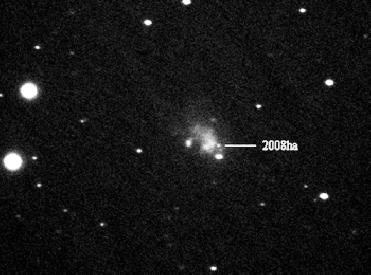
Caption: Colour image of supernova SN 2008ha. A file photo
Credit 10
Credit 10

NEW DELHI (BNS): Supernova SN 2008ha is the first dim supernova in which no hydrogen could be detected. This research has been performed by an international team lead by the Italian astronomer Stefano Valenti (Queen's University in Belfast, UK), including scientists from Max Planck Institute for Astrophysics (Germany), the National Institute for Astrophysics (Italy), and various other institutions.
Several scientific journals published the research result. In the SN 2008ha, the dimness and lack of hydrogen leave room for two scenarios for its origin. One possibility is that the progenitor star may have been a moderately massive star in a binary system, which lost its outer layers through the interaction with the companion.
Alternatively, the explosion may be due to a very massive star which shed its envelope through stellar winds and formed a black hole upon core collapse. If the latter scenario should prove to be correct, SN 2008ha may be of particular importance in understanding the connection between supernovae and a group of gamma-ray bursts, according to a Science Daily press release.
Supernovae are among the most energetic and violent events in the universe. They constitute the final tremendous explosions that end the life cycles of stars more massive than approximately 8 times the Sun.
After running out of fuel, the core of such a star collapses and forms a neutron star or a black hole. At the same time, the outer layers are ejected at high velocity (up to 10% of the speed of light) and shine as brightly as billions of stars together.
Several scientific journals published the research result. In the SN 2008ha, the dimness and lack of hydrogen leave room for two scenarios for its origin. One possibility is that the progenitor star may have been a moderately massive star in a binary system, which lost its outer layers through the interaction with the companion.
Alternatively, the explosion may be due to a very massive star which shed its envelope through stellar winds and formed a black hole upon core collapse. If the latter scenario should prove to be correct, SN 2008ha may be of particular importance in understanding the connection between supernovae and a group of gamma-ray bursts, according to a Science Daily press release.
Supernovae are among the most energetic and violent events in the universe. They constitute the final tremendous explosions that end the life cycles of stars more massive than approximately 8 times the Sun.
After running out of fuel, the core of such a star collapses and forms a neutron star or a black hole. At the same time, the outer layers are ejected at high velocity (up to 10% of the speed of light) and shine as brightly as billions of stars together.