Suzaku's shows X-ray of Galaxy Cluster
Japan-U.S. Suzaku mission will provide X-ray View of a Galaxy Cluster.


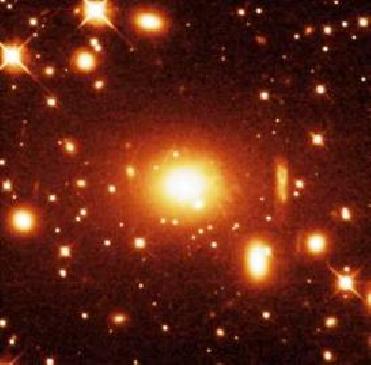
Caption: The massive radio galaxy PKS 0745-191, for which the cluster is named, appears at the center of this Hubble Space Telescope. Photo credit: NASA

NEW DELHI (BNS): For the first time, Japan-U.S. joint Suzaku mission has detected X-ray-emitting gas at a cluster's outskirts, where a billion-year plunge to the center begins. It is also bringing information as how assemblages of thousands of galaxies pull themselves together.
"These Suzaku observations are exciting because we can finally see how these structures, the largest bound objects in the universe, grow even more massive," says Matt George, University of California, as quoted to Science daily.
The team trained Suzaku's X-ray telescopes on the cluster PKS 0745-191, which lies 1.3 billion light-years away in the southern constellation Puppis. Between May 11 and 14, 2007, Suzaku acquired five images of the million-degree gas that permeates the cluster.
Astronomers expect that the gas in the inner part of the cluster is in equilibrium state as the center part is hottest.
"Clusters are the most massive, relaxed objects in the universe, and they are continuing to form now," said team member Andy Fabian at the Cambridge Institute of Astronomy in the UK. The distance where order turns to chaos is referred to as the cluster's "virial radius."
Suzaku's advanced X-ray detectors, coupled with a low-altitude orbit, give the observatory much lower background noise than other X-ray satellites. The low orbit means that Suzaku is largely protected by Earth's magnetic field, which deflects energetic particles from the sun.
"With more Suzaku observations in the outskirts of other galaxy clusters, we'll get a better picture of how these massive structures evolve," added George.
Japanese Institute of Space and Astronautical Science (ISAS) developed Suzaku ("red bird of the south") on July 10, 2005. It is a part of the Japan Aerospace Exploration Agency (JAXA), in collaboration with NASA and other Japanese and U.S. institutions.
"These Suzaku observations are exciting because we can finally see how these structures, the largest bound objects in the universe, grow even more massive," says Matt George, University of California, as quoted to Science daily.
The team trained Suzaku's X-ray telescopes on the cluster PKS 0745-191, which lies 1.3 billion light-years away in the southern constellation Puppis. Between May 11 and 14, 2007, Suzaku acquired five images of the million-degree gas that permeates the cluster.
Astronomers expect that the gas in the inner part of the cluster is in equilibrium state as the center part is hottest.
"Clusters are the most massive, relaxed objects in the universe, and they are continuing to form now," said team member Andy Fabian at the Cambridge Institute of Astronomy in the UK. The distance where order turns to chaos is referred to as the cluster's "virial radius."
Suzaku's advanced X-ray detectors, coupled with a low-altitude orbit, give the observatory much lower background noise than other X-ray satellites. The low orbit means that Suzaku is largely protected by Earth's magnetic field, which deflects energetic particles from the sun.
"With more Suzaku observations in the outskirts of other galaxy clusters, we'll get a better picture of how these massive structures evolve," added George.
Japanese Institute of Space and Astronautical Science (ISAS) developed Suzaku ("red bird of the south") on July 10, 2005. It is a part of the Japan Aerospace Exploration Agency (JAXA), in collaboration with NASA and other Japanese and U.S. institutions.