Gaggle of galaxies challenge conventional cosmic theory
After studying nearly 15 galaxies, astronomers conclude that the celestial bodies are relatively young


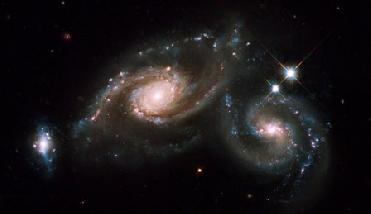
Caption: On April 1-2, NASA's Hubble Space Telescope photographed a group of galaxies. In this image, three galaxies appear to be partially overlapping, although they may be at somewhat different distances. The spiral shapes of two of them appear mostly intact. The third galaxy, to the far left, is more compact, but shows evidence of star formation. Two of the three galaxies are forming new stars at a high rate. Photo credit: AP/PTI
Credit 10
Credit 10

NEW DELHI (PTI): Probing into phases of nativity of galaxies such as the Milky Way and their evolution may no longer remain a distant dream as a team of researchers has found a gaggle of galaxies whose properties suggest their relatively recent constitution.
The recent revelation contradicts the belief that gigantic and radiant galaxies were formed and evolved shortly after Big Bang, nearly 13 billion years ago.
Researchers, in a multi-year study published in the Astrophysical Journal Letters, claimed that the celestial bodies are relatively young aged between three and four billion years.
The sample comprising 15 galaxies present an amount of luminosity (a measure of their total light output) that ascertain their large size, close to that of giant galaxies like Milky Way, while their chemical composition helped to measure the period of their formation, according to John Salzer, principal Investigator and an astronomer at Indiana University.
“These objects may represent a unique window on the process of galaxy formation, allowing us to study relatively nearby systems that are undergoing a phase in their evolution that is analogous to the types of events that, for most galaxies, typically occurred much earlier in the history of the Universe,†Salzer said.
According to the researchers, these galaxies show an abundance of chemical substances suggesting minimum stellar process while the low presence of heavy elements (those heavier than helium are known as metals by astronomers) indicate that they are cosmologically young -- as low as 3 or 4 billion years. Most of the theories pertaining to the formation of galaxies say that giant galaxies like Milky Way, of which our Solar system is a part, were formed some 13 billion years ago, compared to the recent findings that were probably formed 9 to 10 billion years after the Big Bang.
The team of scientists scanned through more than 2,400 star-forming galaxies as a part of the Kitt Peak National Observatory International Spectroscopic Survey conceived to gather basic data on emission-line sources beyond the galaxies.
“Galaxies were selected via their strong emission lines, which is the only way to detect these specific galaxies,†said Salzer.
Along with their relatively new age, these large galaxies might be a consequence of the amalgamation of two smaller ones, the scientists assume. For a closer look into the matter, Sazler and his team intend to request observing time on NASA's Hubble Space Telescope.
The recent revelation contradicts the belief that gigantic and radiant galaxies were formed and evolved shortly after Big Bang, nearly 13 billion years ago.
Researchers, in a multi-year study published in the Astrophysical Journal Letters, claimed that the celestial bodies are relatively young aged between three and four billion years.
The sample comprising 15 galaxies present an amount of luminosity (a measure of their total light output) that ascertain their large size, close to that of giant galaxies like Milky Way, while their chemical composition helped to measure the period of their formation, according to John Salzer, principal Investigator and an astronomer at Indiana University.
“These objects may represent a unique window on the process of galaxy formation, allowing us to study relatively nearby systems that are undergoing a phase in their evolution that is analogous to the types of events that, for most galaxies, typically occurred much earlier in the history of the Universe,†Salzer said.
According to the researchers, these galaxies show an abundance of chemical substances suggesting minimum stellar process while the low presence of heavy elements (those heavier than helium are known as metals by astronomers) indicate that they are cosmologically young -- as low as 3 or 4 billion years. Most of the theories pertaining to the formation of galaxies say that giant galaxies like Milky Way, of which our Solar system is a part, were formed some 13 billion years ago, compared to the recent findings that were probably formed 9 to 10 billion years after the Big Bang.
The team of scientists scanned through more than 2,400 star-forming galaxies as a part of the Kitt Peak National Observatory International Spectroscopic Survey conceived to gather basic data on emission-line sources beyond the galaxies.
“Galaxies were selected via their strong emission lines, which is the only way to detect these specific galaxies,†said Salzer.
Along with their relatively new age, these large galaxies might be a consequence of the amalgamation of two smaller ones, the scientists assume. For a closer look into the matter, Sazler and his team intend to request observing time on NASA's Hubble Space Telescope.