Tool testing begins in Rio Tinto's Mars like conditions
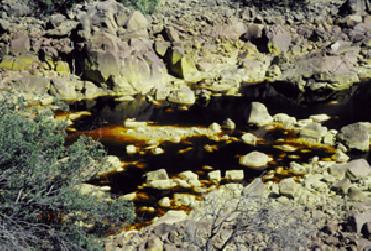
All these tests are for the forthcoming Mission to Mars in 2013. During experiments, scientists were convinced that the water of the Spanish River was very acidic, and similar to what may have flowed on the Martian surface ages ago.


Credit 10

MADRID (BNS): It may astonish many, but it is a fact that conditions like the ones expected in Mars have been located in Rio Tinto in Spain, where life-searching instruments are being tested. All these tests are for the forthcoming Mission to Mars in 2013. During experiments, scientists were convinced that the water of the Spanish River was very acidic, and similar to what may have flowed on the Martian surface ages ago. Even chemical studies have given a clue that rocks on Mars Meridiana Planum plain may have been moved by Rio Tinto-type water.
An expert in hunting for signs of life using spectroscopic techniques on Mars, Fernando Rull Pérez from Centro de Astrobiologia, Madrid, said that they were developing instrument prototypes looking for minerals and organics in Rio Tinto and other similar places. “We are also trying to prepare a scientific model with which we can learn about the possibility of life and how we can extrapolate these models to Mars,” Perez said.
The Madrid scientist is working on a special situ tool that will form part of the European Space Agencys ExoMars mission to the Red Planet. The instrument is popularly known as Raman/LIBS -- after scientist Sir Chandrasekhara Raman -- and LIBS for Laser Induced Breakdown Spectroscopy.
Experts reveal that Raman/LIBS is a spectrometer that uses a laser to “excite” atoms and molecules. “The agitated atoms exhibit more movement than normal, and this atomic dancing can indicate on the kinds of molecules present. Its a cutting edge system which, till date, has been exclusively laboratory-based, so using it in situ is an experiment in itself,” they said.
Even as Pérezs Raman/LIBS spectrometer is being tested for use on ExoMars, it is capable of probing samples up to 20 metres (65 feet) away. Unlike Pérezs contact spectrometer, this updated version wont be ready for ExoMars, but will be used in future missions. Its an exciting time for astro-biologists searching for life, and in situ instruments tested in Rio Tinto are at the forefront of their activities.
An expert in hunting for signs of life using spectroscopic techniques on Mars, Fernando Rull Pérez from Centro de Astrobiologia, Madrid, said that they were developing instrument prototypes looking for minerals and organics in Rio Tinto and other similar places. “We are also trying to prepare a scientific model with which we can learn about the possibility of life and how we can extrapolate these models to Mars,” Perez said.
The Madrid scientist is working on a special situ tool that will form part of the European Space Agencys ExoMars mission to the Red Planet. The instrument is popularly known as Raman/LIBS -- after scientist Sir Chandrasekhara Raman -- and LIBS for Laser Induced Breakdown Spectroscopy.
Experts reveal that Raman/LIBS is a spectrometer that uses a laser to “excite” atoms and molecules. “The agitated atoms exhibit more movement than normal, and this atomic dancing can indicate on the kinds of molecules present. Its a cutting edge system which, till date, has been exclusively laboratory-based, so using it in situ is an experiment in itself,” they said.
Even as Pérezs Raman/LIBS spectrometer is being tested for use on ExoMars, it is capable of probing samples up to 20 metres (65 feet) away. Unlike Pérezs contact spectrometer, this updated version wont be ready for ExoMars, but will be used in future missions. Its an exciting time for astro-biologists searching for life, and in situ instruments tested in Rio Tinto are at the forefront of their activities.