Solar-run UAV Zephyr flies for record 82 hours
The flight trial at Yuma took place from July 28 to 31 in tough conditions of Sonoran Desert with temperatures hovering 45°C (113°F).


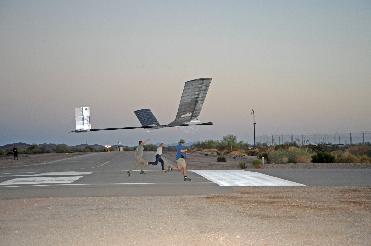

ARIZONA (BNS): Unmanned Aerial Vehicle Zephyr created a world record after it flew non-stop for three-and-a-half days at the US Army's Yuma Proving Ground in Arizona. Zephyr reinforced its reputation as the world's leading solar powered high-altitude long-endurance (HALE) plane flying for 82 hours 37 minutes, exceeding the current official world record for unmanned flight which stands at 30 hours 24 minutes set by Global Hawk in 2001 and Zephyr's previous longest flight of 54 hours achieved last year.
The flight trial at Yuma took place from July 28 to 31 in tough conditions of Sonoran Desert with temperatures hovering 45°C (113°F). Zephyr was flown on autopilot and via satellite communications to a maximum altitude of more than 60,000ft. The trial included a military utility assessment of a US Government communications payload.
Launched by hand, Zephyr is an ultra-lightweight carbon-fibre aircraft. By day it flies on solar power generated by amorphous silicon solar arrays no thicker than sheets of paper that cover the aircraft's wings. By night it is powered by rechargeable lithium-sulphur batteries, supplied by SION Power Inc, which are recharged during the day using solar power.
On the success of Zephyr, Simon Bennett, Managing Director of QinetiQ's Applied Technologies Business said that the Yuma Proving Ground in Arizona was an appropriate setting for Zephyr's world beating flight as many landmark aviation developments have taken place in recent years. “In addition to setting a new unofficial record, the trial is a step towards the delivery of Zephyr's capability for joint, real-time, battlefield persistent surveillance and communications to forces in the field at the earliest opportunity," Bennett said.
Andrew Baird, Director Defence Technology and Innovation Centre, UK MoD said, "MOD is very pleased with the success of the recent trial which demonstrated the potential capability of the technologies in Zephyr. This success has also reinforced the close working relationship between the UK and US on these key technologies."
The flight trial at Yuma took place from July 28 to 31 in tough conditions of Sonoran Desert with temperatures hovering 45°C (113°F). Zephyr was flown on autopilot and via satellite communications to a maximum altitude of more than 60,000ft. The trial included a military utility assessment of a US Government communications payload.
Launched by hand, Zephyr is an ultra-lightweight carbon-fibre aircraft. By day it flies on solar power generated by amorphous silicon solar arrays no thicker than sheets of paper that cover the aircraft's wings. By night it is powered by rechargeable lithium-sulphur batteries, supplied by SION Power Inc, which are recharged during the day using solar power.
On the success of Zephyr, Simon Bennett, Managing Director of QinetiQ's Applied Technologies Business said that the Yuma Proving Ground in Arizona was an appropriate setting for Zephyr's world beating flight as many landmark aviation developments have taken place in recent years. “In addition to setting a new unofficial record, the trial is a step towards the delivery of Zephyr's capability for joint, real-time, battlefield persistent surveillance and communications to forces in the field at the earliest opportunity," Bennett said.
Andrew Baird, Director Defence Technology and Innovation Centre, UK MoD said, "MOD is very pleased with the success of the recent trial which demonstrated the potential capability of the technologies in Zephyr. This success has also reinforced the close working relationship between the UK and US on these key technologies."